
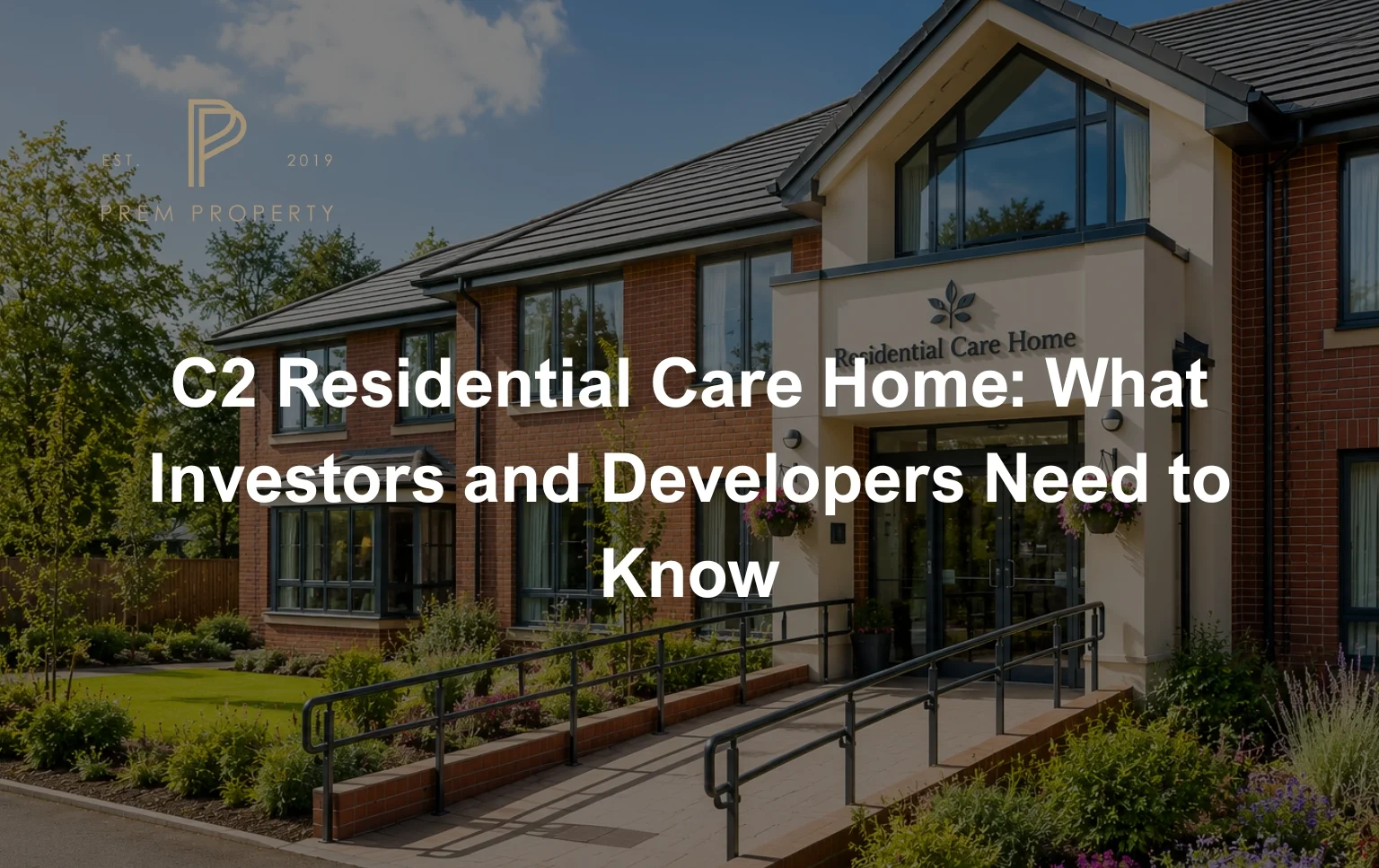
A C2 residential care home is a planning use class under UK law that covers buildings providing both accommodation and care services to people who need them. If you are a property investor or developer looking at this sector, understanding both the planning framework and the operational realities is essential before you commit to a project.
What the C2 Use Class Actually Means
The Town and Country Planning (Use Classes) Order 1987 groups buildings by how they are used, and Class C2 covers Residential Institutions. This includes care homes, nursing homes, hospitals, boarding schools, and residential colleges. What ties them together is that occupants require care, rather than simply having access to it.
That distinction matters more than most people realise. A C3 property is a standard dwelling where a family or individual lives independently. A C2 property is one where the need for care is the defining feature of how the building operates. Swapping between C2 and C3 use is not a minor administrative step. It typically requires a full planning application, and local authorities scrutinise these proposals carefully.
If you want a thorough breakdown of how this use class sits within the wider planning framework, the c2 use class secrets every property investor must know resource covers the nuances that often catch developers off guard. The difference between C2 and neighbouring classes like C2A (secure residential institutions) is also worth knowing, since incorrect classification can derail an entire application.

The Scale of Demand in the UK Market
The numbers behind this sector are striking. London’s planning framework requires 867 new care home beds annually to meet projected demand up to 2029. Yet Knight Frank’s UK care home research projects that 100,000 beds could be at risk of closure by 2040 due to ageing stock, with replacement rates of only 1 to 2 per cent annually. That is a significant structural supply gap.
Consider these headline statistics:
- 76% of existing care homes in England are over 20 years old
- 29% of beds lack en-suite facilities, making them increasingly uncompetitive
- 19% of homes are rated “Requires Improvement” or “Inadequate” by the Care Quality Commission
- Between January 2024 and January 2025, 381 new care homes were registered with an average of 39 residents per home
- Around 60% of care home schemes currently under construction are concentrated in London, the South East, and the South of England
Self-funded residential care currently averages £1,298 per week, which is roughly £67,496 per year. Nursing care is higher still at £1,535 per week. These figures come from LaingBuisson’s UK care market data, a widely cited industry source. For investors, that weekly fee income creates a compelling case for purpose-built, compliant stock.
The 7 planning use classes secrets property investors miss article is worth reading alongside these numbers, because understanding which use classes attract the strongest operator demand affects how you structure the deal from day one.
Regulatory Requirements You Cannot Ignore
Any C2 residential care home operating in England must be registered with the Care Quality Commission, the independent regulator for health and social care. In Wales, oversight falls to Care Inspectorate Wales (CIW), and in Scotland it is the Care Inspectorate. Registration is not optional, and the consequences of operating unregistered are serious.
The CQC assesses homes against five key questions: are they safe, effective, caring, responsive, and well-led? Increasingly, these questions shape planning applications. A local authority will want to see how the building design actively supports CQC’s fundamental standards, not just that a management plan exists.
From a physical design perspective, the requirements for a compliant C2 residential care home include:
- Wide corridors to accommodate wheelchairs and mobility aids
- Passenger lifts where the building is multi-storey
- Accessible wet rooms or en-suite shower facilities
- Adequate staff areas, including rest rooms and admin space
- Fire safety provisions compliant with The Regulatory Reform (Fire Safety) Order 2005
- Safeguarding protocols for vulnerable adults or, in the case of children’s homes, for minors
Homes that care for children are subject to additional oversight from Ofsted. The 10 role of ofsted facts that shape childrens homes article explains how Ofsted’s inspection framework directly influences both the design requirements and operational standards for children’s residential settings specifically.

Planning Considerations for Developers
Getting planning permission for a C2 residential care home is rarely straightforward. You will need to demonstrate that the site is appropriate for the use in terms of location, accessibility, and impact on neighbouring properties. Most local authorities have specific policies on care home provision within their Local Plans, so checking that document early in the process saves time.
Key planning considerations include:
- Demonstrating genuine need for care beds in the local area, often through a needs assessment
- Showing that the site is accessible by public transport, which matters for staff recruitment
- Designing in sufficient car parking, typically at a lower ratio than C3 residential but still required
- Addressing noise, particularly for any outdoor amenity spaces near residential neighbours
- Providing a Management Plan that outlines staffing levels, visitor arrangements, and operational hours
The National Planning Policy Framework sets the broader context, but local variation is significant. Urban sites in London face different viability pressures compared to suburban or rural locations in the Midlands or the North. Understanding the local health and social care landscape, including whether the council has spot-purchasing agreements with operators, will inform your operator search too.
Things to Know
Before you progress a C2 residential care home project, here are six points that developers and investors often overlook:
- A change of use from C2 to C3 is not permitted development. You need full planning permission, and it is often resisted by councils protecting care bed supply.
- CQC registration is site-specific. If you sell the property, the new operator must apply for their own registration, which creates a void period risk.
- Purpose-built stock commands a premium. Operators will pay higher rents for buildings designed specifically for care, rather than converted houses with retrofitted wet rooms.
- Minimum room sizes are not nationally standardised in the way many assume. Check your local authority’s supplementary planning documents for specific guidance.
- Staffing costs represent the largest single operating expense for any care home, typically 50 to 60% of turnover, so design choices that affect staff efficiency directly affect operator viability.
- Forward funding from operators or healthcare REITs is an established exit route for developers, and it is increasingly common on sites of 40 beds or more.

The Investment Case for C2 Property
The combination of ageing stock, constrained supply, and growing demographic pressure makes C2 residential care homes one of the more compelling asset classes in UK property. The c2 property solutions higher returns article explores how investors are structuring deals to capitalise on this imbalance between demand and quality supply.
Net initial yields for care homes typically range from 5% to 7% for well-specified, well-located assets, though value-add opportunities in refurbishing older stock can offer higher returns. Long leases, typically 20 to 35 years with upward-only rent reviews, provide income security that is hard to find in standard residential or commercial property.
Comparison of C2 care home investment structures:
| Structure | Typical Lease Length | Yield Range | Key Risk |
|---|---|---|---|
| Forward fund (new build) | 25-35 years | 5.0-5.75% | Construction and planning |
| Sale and leaseback | 20-30 years | 5.5-6.5% | Operator covenant strength |
| Refurbishment and lease | 15-25 years | 6.0-7.5% | Occupancy ramp-up period |
| Direct operation | N/A | 10%+ (gross) | Full operational exposure |
The NHS Long Term Plan reinforces the strategic case. Bed capacity in the social care sector directly affects hospital discharge rates, and policy pressure to keep older people in appropriate residential settings rather than hospital beds is only going one way.

Ready to Advance Your C2 Development?
If you are serious about progressing a C2 residential care home project, the single most valuable step you can take right now is to commission a proper needs assessment for your target location. Contact your local Clinical Commissioning Group successor body (Integrated Care Board) and the council’s adult social care commissioning team. Ask directly whether they have unmet demand for care beds and whether they operate spot-purchasing or block-contract arrangements with care home operators. That conversation will tell you more about the viability of your project than any desktop research, and it will significantly strengthen your planning application when you make it.
Frequently Asked Questions
Q: Do you need planning permission to convert a house into a C2 residential care home?
Yes, you almost always need a full planning application to change a property to C2 use from C3.
A standard house falls under C3 use, and converting it to a care home is a material change of use. You will need to submit a planning application with supporting documents including a design and access statement, a needs assessment, and typically a management plan.
Q: What is the minimum number of residents that defines a C2 care home versus a C3 house with a live-in carer?
The legal threshold sits at more than six residents, after which a property is generally considered a C2 use rather than a sui generis or C3 use.
Homes with fewer than seven residents providing care can sometimes fall into a grey area, and local planning authorities have discretion. If you are unsure about the classification of a specific property, seeking a Lawful Development Certificate from the council provides legal certainty.
Q: How long does CQC registration take for a new care home?
CQC registration typically takes between three and six months from submitting a complete application, though complex cases can take longer.
The process involves a fit person interview with the nominated individual, an assessment of your statement of purpose, and a pre-registration inspection of the premises. Starting this process early, ideally while your planning application is still being determined, reduces your overall development timeline considerably.
Q: Can a C2 care home be used for both elderly residents and children?
No, a single C2 registered care home cannot simultaneously operate as both an elderly care facility and a children’s home, as these require separate registrations with different regulators.
Elderly care homes are registered with the CQC, while children’s homes are registered with and inspected by Ofsted. The physical standards, staffing ratios, and safeguarding requirements differ substantially between the two.
Q: What yields do purpose-built C2 care homes typically generate for investors?
Purpose-built care homes on long leases typically offer net initial yields of between 5% and 7%, depending on location, operator covenant, and lease terms.
New build assets let to established operators on 25-year leases with full repairing and insuring terms are priced more keenly, often in the 5 to 5.75% range. Older stock or smaller operators may offer higher yields to reflect the additional risk involved.
The Bottom Line on C2 Residential Care Home Investment
The C2 residential care home sector sits at the intersection of demographic inevitability and chronic undersupply. With 100,000 beds at risk of closure by 2040 and replacement rates that cannot keep pace, the case for well-designed, compliant new supply is strong. However, success in this sector requires you to understand the planning framework, build relationships with operators early, and design with CQC standards baked in from the outset.
Start with your planning pre-application meeting and your local Integrated Care Board conversation. Both conversations will shape your project more than any amount of desktop research. The developers who do well in this asset class are the ones who treat care as a service first and property second.