
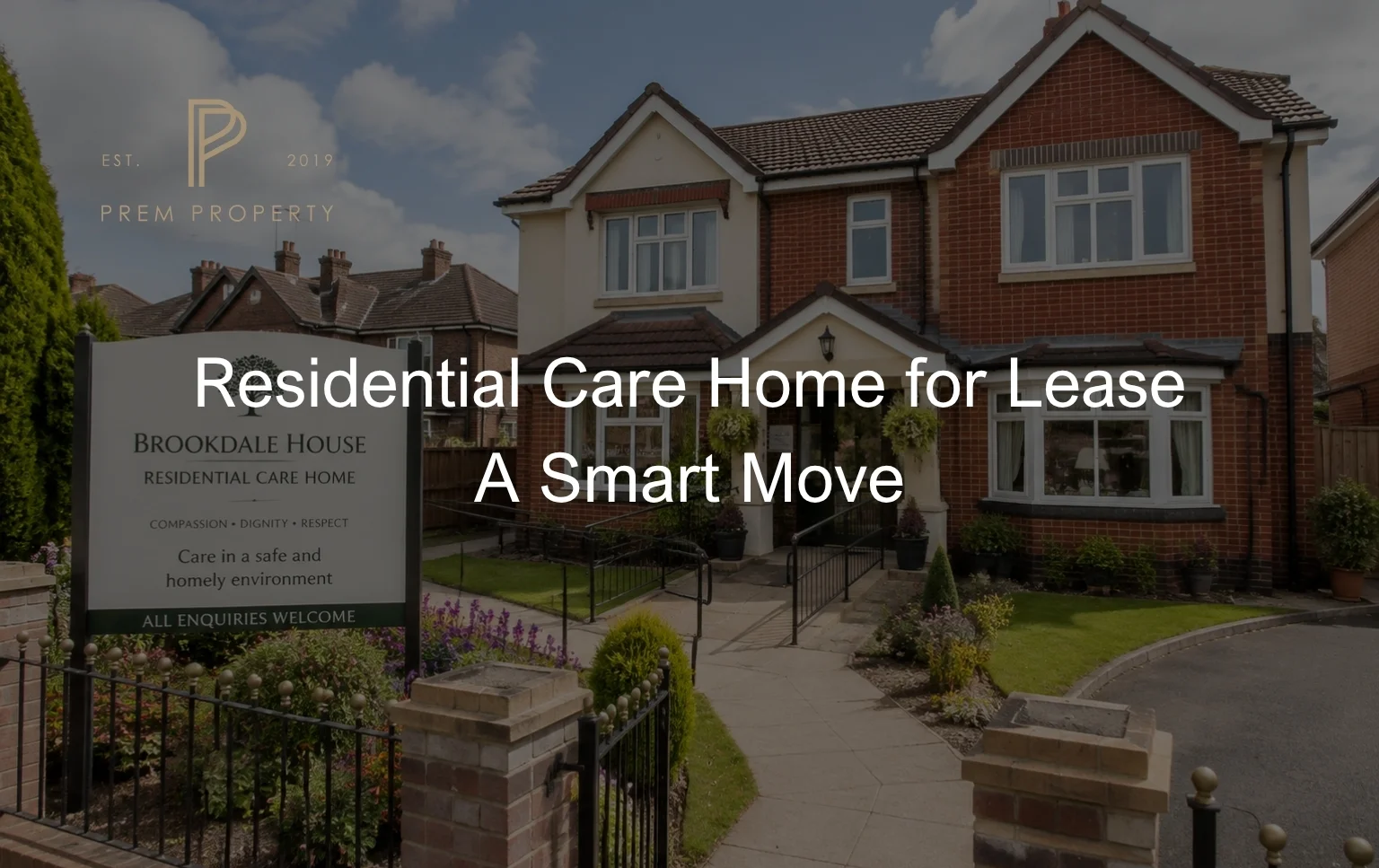
Leasing a residential care home is one of the most structured ways for property investors and care providers to enter the specialist housing market without the immediate burden of full ownership. A residential care home for lease allows both parties to establish clear responsibilities, income arrangements and operational boundaries from the outset, making it an increasingly attractive option across the UK property sector.
Table of Contents
- Why Leasing a Care Home is Gaining Traction
- How a Residential Care Home Lease Works
- What Landlords Need to Understand Before Leasing
- Care Home Lease vs Outright Purchase
- Regulatory and Planning Requirements
- Finding the Right Property in the Right Location
- How Prem Property Supports Care Home Leasing
Key Takeaways
- A residential care home for lease separates property ownership from care operations, benefiting both landlords and providers.
- Lease structures in the care sector typically involve longer terms, often between five and twenty-five years, providing income stability for landlords.
- Regulatory compliance, including CQC registration and planning use class, must be addressed before any lease is signed.
- Properties used as residential care homes generally fall under C2 use class, which carries specific planning and building requirements.
- Working with a specialist property partner like Prem Property can simplify sourcing, compliance and lease structuring significantly.
- Location matters enormously — proximity to transport, community services and staffing pools directly affects the viability of a care home operation.
Why Leasing a Care Home is Gaining Traction
The UK care sector is under sustained pressure. An ageing population, rising demand for supported accommodation and a shortage of suitable registered properties have created a market where quality care homes are genuinely difficult to source. This is precisely why the leased care home model has become more prominent.
For care providers, leasing avoids the substantial capital outlay of purchasing a freehold property, freeing up resources for staffing, equipment and service delivery. For landlords and property investors, a long-term lease to an established operator offers reliable income without the operational complexity of running a care business. It is a clean division of responsibility that, when structured properly, benefits both sides considerably.
The demand is not limited to elderly care. Across the Midlands and Greater London, there is growing appetite for residential properties suitable for children’s homes, supported living schemes and specialist residential accommodation. Investors who understand the distinction between standard buy-to-let and specialist care property are increasingly well-placed to serve this growing need.
Prem Property, based in Birmingham, West Midlands, has been working within this space since 2019, connecting landlords with registered care and housing providers across the Midlands and Greater London by providing information through blogs that cover everything from market insights to operational guidance. Their work highlights just how much appetite exists on both sides of this equation and how little of that demand is currently being met through conventional property channels.
How a Residential Care Home Lease Works
At its core, a care home lease is a commercial property agreement between a landlord and a care operator. The landlord retains ownership of the building while the operator takes on responsibility for running the care service from the premises. The lease defines rent, term length, permitted use, repair obligations and exit conditions.
Lease terms in the care sector tend to be considerably longer than standard residential tenancy agreements. It is common to see terms of ten, fifteen, or even twenty-five years, reflecting the significant investment care operators make in adapting a property, training staff and obtaining regulatory registration.
Rent is typically set at a fixed amount, often with structured review periods tied to the Retail Price Index or a fixed annual uplift percentage. This predictability is one of the primary attractions for landlords who want steady, long-term income without active management involvement.
Operators will usually expect certain property standards before signing. The building must meet fire safety requirements, accessibility standards and the specifications laid out by the relevant regulatory body. In England, that body is the Care Quality Commission, which inspects and registers providers of personal care and healthcare services.
Reading through the detail of a care property lease before committing is essential. Minor oversights in clauses related to repairing obligations, alterations, or break rights can create significant disputes down the line.
What Landlords Need to Understand Before Leasing
Landlords entering the care leasing market for the first time often underestimate how different it is from residential letting. The tenant is not an individual household; they are a registered business operating under statutory obligations. That changes the dynamic substantially.
Key considerations for landlords include:
- Use class and planning permission: Residential care homes in England typically require C2 planning permission. If your property currently holds a C3 (dwelling house) designation, a change of use application will likely be needed before a care operator can legally trade from the premises.
- Building adaptations: Operators may need to make structural or cosmetic changes to meet regulatory standards. Landlords should be clear in the lease about which adaptations are permitted and who bears the cost.
- Rent security: Unlike standard lets where tenant default is a known risk, care operators often receive funding from local authorities or the NHS, which can provide a degree of income stability. However, this is not guaranteed and due diligence on the operator’s financial standing remains important.
- Long lease commitments: Agreeing to a fifteen or twenty-year lease requires confidence in both the operator and the property’s suitability. Landlords should take independent legal advice before signing.
- Exit strategy: What happens at the end of the lease, or if the operator ceases trading? These scenarios must be addressed clearly within the agreement.
The NHS England guidance on adult social care provides useful context on how commissioning relationships work and how that affects the financial sustainability of care operators, which in turn affects the security of your lease income.

Care Home Lease vs Outright Purchase
For investors weighing their options, the lease versus purchase question is worth careful consideration.
| Factor | Residential Care Home for Lease | Outright Purchase |
|---|---|---|
| Upfront Capital Required | Lower (lease costs vs purchase price) | High (freehold acquisition costs) |
| Income Potential | Rent received from operator | Can include operational profits |
| Risk Level | Lower for landlord; shared with operator | Higher operational and market risk |
| Regulatory Involvement | Minimal for landlord | Significant if operating directly |
| Flexibility | Locked in for lease term | Greater control over disposal |
| Suitable For | Passive investors, portfolio landlords | Care operators, active investors |
For most property investors without a care background, leasing the property to a registered operator is the more practical route. It provides income without requiring CQC registration, staffing knowledge, or care sector experience.
For care providers, leasing preserves working capital and allows faster expansion across multiple sites than purchasing each property would permit.
Regulatory and Planning Requirements
This is the area that trips up even experienced property investors. The regulatory environment around residential care is detailed and the consequences of getting it wrong are serious.
The starting point is planning use class. In England, properties used for residential care fall under the C2 classification. Converting a standard dwelling into a care home requires a formal change of use application to the local planning authority. This process can take several months and is not guaranteed to be approved. Local authorities will assess factors including traffic impact, neighbourhood character and building suitability.
Beyond planning, operators must meet the standards set by the Care Quality Commission before they can admit residents. These care home requirements cover a wide range of areas, from fire safety and accessibility through to staffing ratios and governance frameworks. Landlords do not need to obtain CQC registration themselves, but the property must be capable of meeting CQC standards if the operator is to secure their registration.
For children’s homes specifically, Ofsted rather than the CQC holds regulatory responsibility. This adds another layer of specificity to property requirements, covering room sizes, outdoor space and structural suitability. Those considering specialist housing in this category should factor Ofsted standards into their property assessment from the very beginning.
The Planning Portal provides detailed guidance on change of use applications in England, which is a useful starting resource for investors exploring their planning options.

Finding the Right Property in the Right Location
Not every property is suitable for a care home lease arrangement and not every location will attract an operator willing to sign a long-term agreement.
Care operators look for properties that are:
- Large enough to accommodate residents comfortably, with adequate bedroom sizes and communal space
- Accessible for residents with mobility needs
- Located near community amenities, healthcare services and public transport
- In areas with sufficient workforce supply to staff the home adequately
- Structurally sound, with no significant remedial works outstanding
The Midlands and Greater London are two of the most active regions for specialist care property demand. Birmingham, in particular, has seen continued growth in the need for residential care provision. Investors exploring residential care home Birmingham opportunities will find a market with genuine depth of demand from both local authorities and independent care providers.
Outside Birmingham, areas across the West Midlands including Wolverhampton, Coventry and Solihull have also seen growing enquiry from care operators seeking suitable properties.
Investors should also be mindful that some local authorities are more active than others in commissioning placements. Building relationships with the commissioning teams at local councils, or working with a property partner who already has those connections, can dramatically accelerate the process of matching a property with a suitable operator who holds cqc registered home care credentials.

How Prem Property Supports Care Home Leasing
Prem Property was founded in May 2019 with a specific purpose: to make the social and specialised housing sector more accessible and more workable for landlords and providers alike. That mission sits directly at the intersection of what a residential care home for lease arrangement requires.
For landlords, Prem Property offers guaranteed rent solutions that provide reliable income without the need to manage a care operation or deal with the day-to-day complexity of regulated residential care. The company handles property management, compliance support and landlord communication, reducing the administrative burden considerably.
For care providers and housing organisations, Prem Property offers property procurement services that tap into its established landlord network. Rather than approaching individual landlords separately, providers can work with Prem Property to identify suitable properties efficiently, shortening the time from identification to occupation.
The company’s expertise spans Residential Children’s Homes, C2 Residential Care Properties and Supported Living, across the Midlands and Greater London. That breadth of experience means they understand the specific property requirements, planning considerations and regulatory expectations that differ between these categories.
Those looking to go deeper into the subject can visit the Prem Property website for practical articles covering topics across the specialist housing and guaranteed rent space.
The Royal Institution of Chartered Surveyors also provides guidance on commercial property leasing standards in the UK, which can serve as a useful independent reference when structuring or reviewing care home lease agreements.
For landlords who want to understand how the model compares to traditional buy-to-let, or for care operators looking to understand what a property partner can realistically offer, working with a specialist like Prem Property removes much of the guesswork from what is otherwise a complex and highly regulated market.
Things to Know
- A residential care home for lease is classified differently from a standard residential let in the eyes of both planners and lenders. Mortgage products designed for buy-to-let properties are generally not suitable for care home leasing arrangements, so specialist finance advice is strongly recommended.
- The length of a care home lease directly affects the property’s value. A well-structured long-term lease to a credible, CQC-registered operator can enhance the asset’s appeal to future buyers or refinancing lenders.
- Not all care operators are equal. Before granting a lease, landlords should request evidence of CQC registration, proof of local authority commissioning relationships and recent inspection reports. A registered operator with a “Good” or “Outstanding” CQC rating is a markedly safer leasing partner.
- Change of use from C3 to C2 planning class is not automatic. Local planning authorities assess each application individually and refusal is possible. Investors should budget for planning costs and timelines before purchasing a property with care home conversion in mind.
- Service charge and maintenance responsibilities vary widely between leases. Some operators take on full repairing and insuring obligations, while others pass significant costs back to the landlord. Clarifying this upfront avoids costly disputes mid-lease.
- Vacant possession at the end of a long lease can be complicated if the operator has made structural adaptations. Reinstatement clauses in the lease agreement protect the landlord’s position and should never be overlooked during the drafting stage.
Take the Next Step With Prem Property
Finding the right arrangement for a residential care home for lease requires specialist knowledge, established networks and a property partner who understands both the landlord’s need for reliable income and the provider’s need for a suitable, compliant property. That combination is not easy to find through conventional letting agents or standard property portals.
Prem Property works with landlords, investors and care providers across the Midlands and Greater London, offering guaranteed rent solutions, property procurement and professional property management tailored specifically to the specialist housing sector. Whether a landlord has an existing property with care home potential or an investor is actively seeking a suitable acquisition, the team at Prem Property can provide practical, experienced guidance from the outset.
Visit premproperty.co.uk today to speak with the Prem Property team and explore how a guaranteed rent solution or property procurement partnership could work for your situation.
Frequently Asked Questions
Q: What is the typical lease length for a residential care home in the UK?
Residential care home leases in the UK commonly run between ten and twenty-five years, though shorter arrangements of five to ten years do exist depending on the operator and property type.
The length reflects the significant investment operators make in adapting a property, obtaining regulatory registration and building a local care reputation. Longer leases also benefit landlords by reducing the frequency of re-letting periods and providing more predictable, stable income over time. Each agreement should be negotiated individually, with both parties taking independent legal advice before signing.
Q: Does a landlord need CQC registration to lease a property to a care operator?
No. A landlord does not need to hold CQC registration to lease a property to a registered care operator. CQC registration is the responsibility of the care provider, not the property owner.
The landlord’s responsibility is to ensure the property is structurally suitable, meets relevant building regulations and has the correct planning use class in place before the operator takes occupation. The operator then applies for CQC registration based on their intended service model and the specific premises. Landlords should, however, satisfy themselves that any prospective operator already holds or is actively pursuing the appropriate registration before committing to a long-term lease.
Q: What planning permission is needed to convert a residential house into a care home?
In England, converting a standard dwelling house from C3 use to a residential care home requires a change of use application to the local planning authority, as care homes fall under C2 use class.
This is a formal application process that involves submitting details of the proposed use, building layout, access arrangements and any structural alterations. The local authority will consult neighbours and assess the application against local planning policies. Approval is not guaranteed and the process can take several months. Investors should factor planning risk into their financial modelling before purchasing a property with this intention.
Q: How does guaranteed rent work when leasing a care home property?
A guaranteed rent arrangement means the landlord receives an agreed fixed rental income from a property partner or operator regardless of occupancy levels within the care home itself.
Rather than being paid only when the care home is full or when the operator generates sufficient revenue, the landlord’s income is secured by the terms of the lease or the guaranteed rent agreement. Prem Property structures these arrangements so that landlords receive reliable income while the care or housing provider manages the occupancy and operational side. This separation of financial responsibility is one of the primary reasons specialist guaranteed rent solutions are attractive to property investors entering the care sector.
Q: What types of properties are most suitable for a residential care home lease arrangement?
Properties that work best for care home leasing tend to be detached or semi-detached houses with multiple bedrooms, accessible layouts, sufficient communal space and proximity to healthcare services and public transport.
Operators look for buildings that can be adapted to meet regulatory standards without excessive structural upheaval. Ground-floor bedrooms or the ability to install a lift, wide doorways, accessible bathrooms and adequate outdoor space are all factors that influence a property’s suitability. Location matters considerably too, as operators need to recruit care staff locally and maintain relationships with commissioning bodies in the area. Properties in the Midlands and Greater London, where demand for specialist residential care provision is particularly active, tend to attract stronger operator interest.
The Bottom Line on Residential Care Home for Lease
Leasing a residential care home is a specialist undertaking that sits well outside the scope of conventional property investment. The rewards, when the arrangement is structured correctly, are significant: long-term income stability, reduced day-to-day management and a positive contribution to a sector that genuinely needs quality housing. However, the regulatory complexity, planning requirements and due diligence involved mean that going in without specialist support is a risk most investors would be wise to avoid.
The strongest outcomes in this market consistently come from landlords and providers who work with experienced partners who understand both sides of the equation. Prem Property brings that dual perspective, combining guaranteed rent expertise with deep knowledge of specialist housing requirements across the Midlands and Greater London. If a residential care home for lease is on your investment radar, reaching out to a specialist is the clearest, most practical action step available right now.