
The UK care sector continues to create opportunities for landlords who own larger residential properties that may be suitable for specialist accommodation.
For the right property, moving away from conventional residential letting can create a more structured long-term arrangement while also allowing the building to serve an important social purpose.
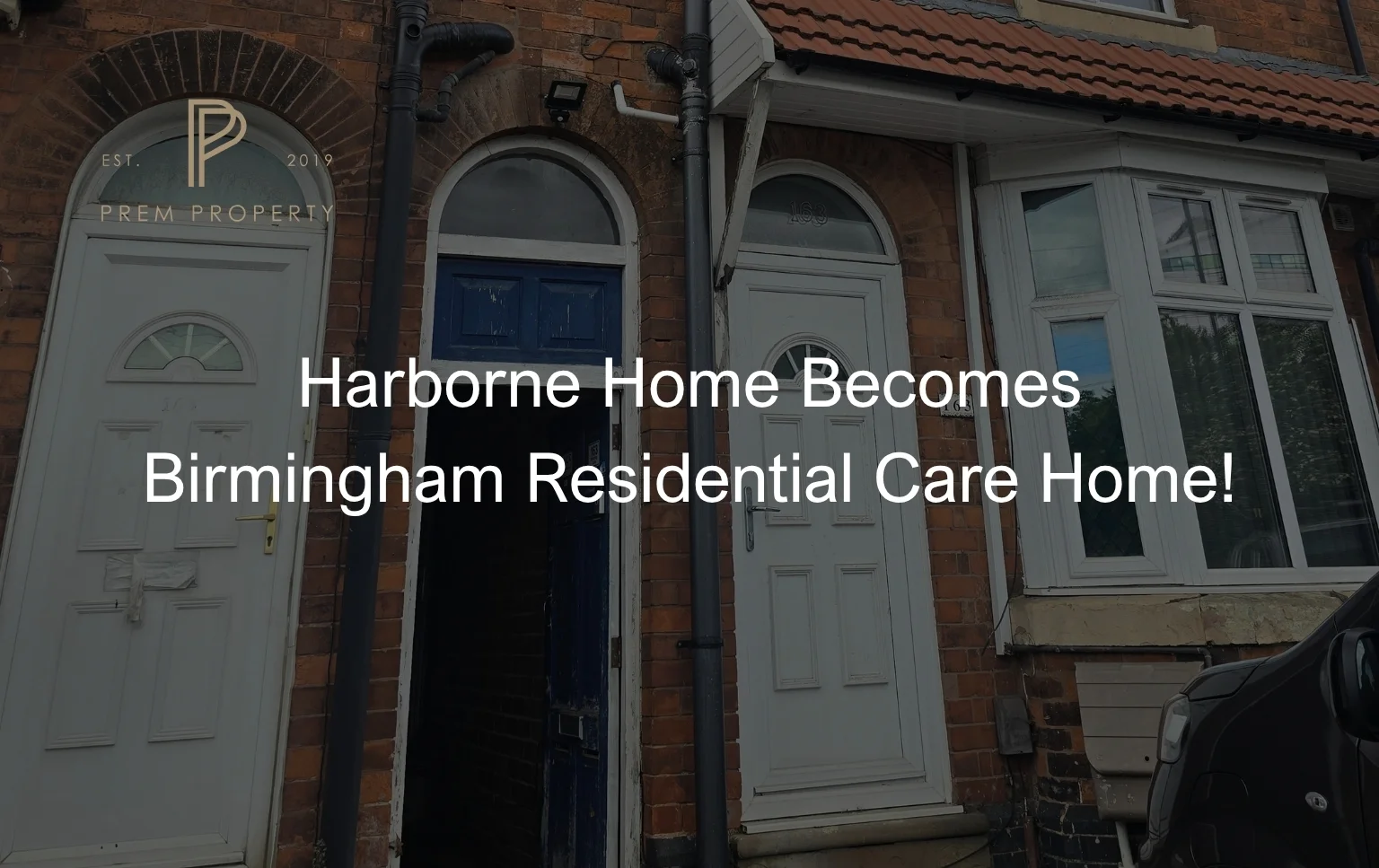
That is exactly what happened with this six-bedroom property in Harborne, Birmingham.
Rather than continuing as conventional shared accommodation, the property was repositioned as a residential care home supporting adults with mental health needs.
A five-year commercial lease was agreed with Servol Community Services, while Prem Property now manages the property on behalf of the landlord.
The result is a long-term arrangement that brings together the landlord, an experienced care provider and professional property management.
Recognising the Potential of the Property
Not every residential property is naturally suited to care-related accommodation.
The size, internal configuration, bathroom provision, communal facilities, accessibility and location all play an important role when assessing whether a property may work for a specialist provider.
The Harborne property already had several characteristics that made it particularly attractive.
It comprises:
- Six individual bedrooms
- Six bathrooms
- A modern communal kitchen
- Shared hallway and staircase
- Paved front driveway
- Side access
- Rear patio
- Long enclosed garden
The six-bedroom configuration was particularly important.
Each resident could have their own private bedroom while continuing to benefit from shared areas within the home.
The property also benefits from an unusually strong level of bathroom provision, with six bathrooms serving six bedrooms.
This provides residents with greater privacy and reduces pressure on communal facilities.
For people who may require ongoing mental health support, having appropriate personal space alongside shared areas can contribute to creating a more comfortable residential environment.
The existing accommodation therefore provided a strong foundation for a care provider looking for a residential setting rather than a large institutional environment.

Moving Beyond Conventional Residential Letting
Larger residential properties can sometimes create greater management demands for landlords.
Where properties are occupied by several individual tenants, landlords may need to deal with frequent tenant changes, room marketing, maintenance requests, compliance obligations and ongoing communication with multiple occupiers.
For this landlord, the objective was to create a more stable and structured arrangement.
Rather than managing the property as conventional residential accommodation, the opportunity was identified to lease the property through a long-term specialist arrangement with a professional care organisation.
The property is now used as a residential care home for adults with mental health needs.
Instead of relying on several individual occupants, the property operates under one organisational lease.
This provides a much clearer relationship between the landlord and the organisation responsible for operating the home.
It also creates a stronger separation between property ownership and the day-to-day delivery of care.
Working with Servol Community Services
The property is operated by Servol Community Services, which supports adults with mental health needs within a residential environment.
Servol Community Services focuses on providing residents with appropriate support while helping them maintain as much independence as possible.
The home itself plays an important role in that model.
Rather than creating an institutional environment, the property provides residents with individual bedrooms, bathroom facilities, communal areas and outdoor space within a traditional residential setting.
This allows the building to continue feeling like a home while providing a suitable environment for ongoing support.
The Harborne property is leased to Servol Community Services under a five-year commercial agreement, creating greater long-term stability for both the care provider and the property owner.
For the provider, a longer lease makes it possible to establish continuity within the home and provide residents with a more stable environment.
For the landlord, it creates a more predictable long-term property strategy.
Supporting Adults with Mental Health Needs
Residential accommodation for adults with mental health needs involves considerably more than simply providing bedrooms.
The environment needs to support safety, privacy, independence and everyday living.
The design and configuration of the Harborne property help to achieve this balance.
Each resident has access to private accommodation while the communal areas provide opportunities for interaction and shared daily activities.
The modern kitchen provides an important communal environment within the home while the garden offers residents additional outdoor space.
The property therefore combines several important elements.
Privacy
Residents have access to individual bedrooms rather than shared sleeping accommodation.
Having personal space can help residents maintain greater independence and provide somewhere they can retreat to when they need privacy.
Bathroom Provision
With six bathrooms across the property, residents benefit from greater privacy and reduced reliance on heavily shared facilities.
Communal Areas
Shared spaces allow residents to interact and participate in everyday activities while remaining part of a residential community.
Outdoor Space
The rear garden provides an additional area for recreation, relaxation and general wellbeing.
Residential Surroundings
The building retains the appearance and atmosphere of a traditional home rather than a large institutional facility.
Together, these characteristics provide an environment that is well suited to longer-term residential support.

A Five-Year Long-Term Arrangement
One of the most significant aspects of the transaction is the five-year lease.
Longer commercial leases can provide important benefits when properties are used within the care sector.
Care providers require stability.
Once a property has been established as a home for residents, frequent moves can create operational challenges and may disrupt the stability of the people living there.
A longer lease gives the provider greater certainty and enables services to be delivered within a more consistent environment.
The landlord also benefits from greater certainty compared with repeatedly letting rooms or entering into shorter residential arrangements.
This type of structure can form part of a wider guaranteed rent solution for landlords, helping property owners create greater income stability while reducing some of the management demands associated with conventional letting.
Instead of constantly dealing with changing individual occupiers, the property is leased to one organisation responsible for operating the home.
This creates a more structured landlord and tenant relationship.
Prem Property’s Role
Prem Property’s property and guaranteed rent solutions extend beyond simply arranging a lease.
Prem Property now manages the Harborne property on behalf of the landlord, providing ongoing management throughout the relationship with Servol Community Services.
This is particularly important with specialist properties.
A landlord may own a suitable building but may not want to deal directly with every maintenance question, operational matter or communication arising during a long-term commercial lease.
Prem Property acts as the central property management contact.
Our ongoing role includes:
- Managing communication between the landlord and care provider
- Providing property management oversight
- Monitoring property-related responsibilities
- Coordinating maintenance matters where required
- Helping to ensure issues are directed to the responsible party
- Supporting the landlord throughout the lease
- Monitoring the condition of the property
- Helping to protect the long-term value of the asset
This gives the landlord a more hands-off ownership experience without losing professional oversight.
Rather than simply introducing a care provider and stepping away once the agreement is completed, Prem Property remains involved throughout the management period.
Clearly Defined Responsibilities
A successful specialist property arrangement requires clear responsibilities.
The commercial lease structure helps to establish which matters remain with the landlord and which become the responsibility of the care provider.
The landlord remains primarily responsible for major structural elements of the property.
These include areas such as:
- Foundations
- Load-bearing walls
- Structural floors
- Structural roof elements
- Relevant building insurance responsibilities
The care provider assumes responsibility for much of the routine maintenance and operational upkeep.
This includes matters such as:
- Internal repairs
- General maintenance
- Fixtures and fittings
- Plumbing
- Heating systems
- Electrical systems
- Boiler servicing
- Reactive maintenance
- General property upkeep
This structure is important because it reduces ambiguity.
When a maintenance issue arises, Prem Property can help determine the appropriate responsibility and ensure it is directed to the correct party.
This creates a more efficient management process and helps to reduce unnecessary disputes between the landlord and operator.
Compliance Within a Care Environment
Operating a residential care property also requires a strong focus on safety and regulatory compliance.
The care provider is responsible for maintaining the certifications, assessments and statutory requirements relevant to the occupation and operation of the property.
Depending on the requirements applicable to the care model, these may include:
- Energy Performance Certificates
- Gas Safety Certificates
- Electrical Installation Condition Reports
- Fire alarm certification
- Emergency lighting certification
- Fire Risk Assessments
- Legionella risk assessments
- Relevant care-related regulatory requirements
- Other statutory occupation and property compliance obligations
The care provider is also responsible for ensuring that relevant safety checks are carried out and that applicable non-structural remedial works are addressed.
Prem Property maintains oversight from the landlord’s property management perspective while Servol Community Services manages the operational requirements associated with delivering care.

Establishing the Condition of the Property
Before the property entered its new long-term arrangement, a detailed Schedule of Condition was prepared.
This documented the condition of the bedrooms, bathrooms, kitchen, communal spaces and external areas.
The inspection showed that the majority of the property was in good structural condition while also recording a number of minor maintenance matters.
These included:
- Minor mould or residue around some shower seals
- Limescale and watermarks within one bathroom
- Wall scuffs
- Localised plaster and paint damage
- A loose or partially detached smoke detector
- An overgrown rear lawn
- General garden tidying requirements
A photographic record was also prepared alongside information relating to keys and utility meter locations.
This documentation creates a clear starting point for the management relationship.
For Prem Property, it also provides a baseline against which the condition of the property can be monitored throughout the lease.
Why Harborne Works for Specialist Accommodation
Location is another important consideration when assessing residential care properties.
Harborne is an established area of Birmingham with access to the wider city’s transport connections, healthcare infrastructure and community services.
For specialist accommodation, connectivity matters.
Residents and care providers may require access to healthcare appointments, support services, shops, public transport and other community facilities.
A property that combines an appropriate internal configuration with access to a major urban area can therefore be particularly attractive to specialist organisations.
The Harborne property combines both.
It provides the physical accommodation required for residents while remaining within Birmingham’s wider urban infrastructure.
Creating Value Beyond Traditional Letting
This case study highlights an important point for landlords with larger residential properties.
The value of a property does not always need to be considered solely through traditional residential rent.
In the right circumstances, a building may have greater long-term potential when matched with an organisation operating within the supported housing or care sector.
Landlords considering this strategy can also explore property investment in specialist housing and C2 homes to understand how suitable properties can potentially be aligned with specialist providers.
However, creating a successful long-term arrangement involves more than simply finding a care provider.
The property needs to be suitable.
The lease needs to be structured properly.
Responsibilities need to be clearly defined.
The operator needs an environment that meets the needs of residents.
The landlord needs confidence that the asset will continue to be professionally managed.
Ongoing communication and property management are also essential.
This is where specialist property expertise can make a significant difference.
Other Prem Property projects demonstrate similar approaches, including our Brierley Hill care home case study, where an existing property investment was repositioned for use within the care sector.
A Partnership Between Property and Care
The Harborne arrangement brings together three parties with clearly defined roles.
The landlord retains ownership of the property.
Servol Community Services operates the residential care home and supports the adults living there.
Prem Property manages the property on behalf of the landlord and provides ongoing oversight of the property relationship.
Each party can therefore concentrate on its core responsibility.
The landlord holds the asset.
The care provider focuses on supporting residents.
Prem Property focuses on protecting and managing the property relationship.
This creates a more structured long-term partnership than a conventional landlord and individual tenant arrangement.
The Result
The property has successfully moved from conventional residential accommodation into a six-bedroom residential care home supporting adults with mental health needs.
Today, the arrangement provides:
- Six private bedrooms
- Six bathrooms
- Residential care accommodation
- Support for adults with mental health needs
- A five-year commercial lease
- Servol Community Services as the care provider
- Clearly allocated maintenance responsibilities
- Professional property management by Prem Property
Most importantly, the property now has a clear long-term purpose.
For the landlord, the arrangement provides a more structured and professionally managed approach to property ownership.
For Servol Community Services, it provides a stable residential environment from which it can support adults with mental health needs.
For residents, it provides private accommodation and communal facilities within an environment designed to feel like a home.
For Prem Property, this project demonstrates the value of looking beyond the initial transaction.
Our involvement does not finish when a care provider moves into a property.
Prem Property continues to manage the property, oversee the landlord and provider relationship and help to protect the asset throughout the lease.
The Harborne project demonstrates what can be achieved when the right property, the right care provider and the right management structure come together.
For landlords considering the future of a larger residential property, specialist care accommodation may offer an alternative long-term strategy that combines professional property management with meaningful social purpose.
Explore more Prem Property case studies to see how other properties have been repositioned for specialist housing, care and long-term property solutions.