
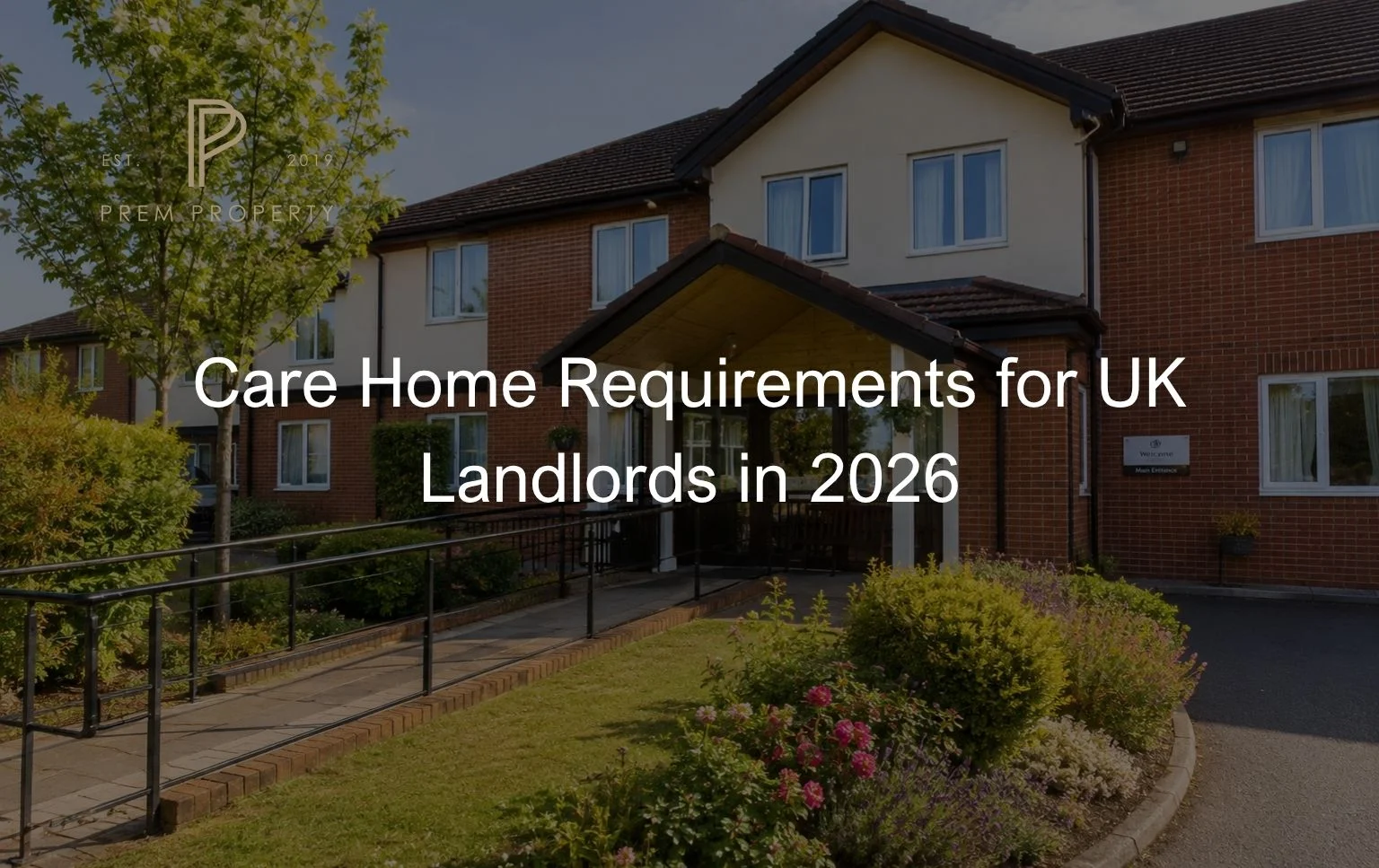
Meeting care home requirements in the UK means satisfying a combination of regulatory, physical and operational standards set by the Care Quality Commission (CQC), local planning authorities and fire safety legislation. For landlords and property investors, understanding these requirements is not just about compliance — it is also about unlocking a resilient and growing sector of the UK property market.
Key Takeaways
- CQC registration is mandatory for any provider operating a regulated care home in England.
- Properties must meet specific physical standards covering space, accessibility, fire safety and room dimensions.
- Planning use class matters: most residential care homes require C2 classification, not standard C3 residential.
- Landlords do not need to operate care homes themselves — they can lease properties to registered providers.
- Prem Property, based in Birmingham, supports landlords and investors in navigating specialist housing requirements across the Midlands and Greater London.
- Guaranteed rent solutions can provide landlords with stable income from care-sector properties without the operational burden of running a care service.
Why Care Home Property Standards Are More Complex Than Standard Lettings
Residential care homes occupy a very different regulatory space compared to standard buy-to-let properties. A landlord renting a house to a family is subject to housing legislation, gas safety regulations and energy performance requirements. A property used as a care home carries all of those responsibilities plus an additional layer of sector-specific compliance.
The Care Quality Commission is the independent regulator of health and social care in England. Any provider wishing to operate a registered care home must be registered with the CQC before admitting residents. The CQC assesses services against five key questions: are they safe, effective, caring, responsive and well-led? Providers who fail inspections risk having their registration suspended or cancelled.
For the property itself, the building must be physically capable of supporting care delivery. This means more than just having enough bedrooms. Corridors, bathrooms, communal areas and outdoor spaces all form part of what regulators and commissioning bodies will assess when deciding whether a property is suitable for care use.
Understanding cqc registered home care requirements is therefore essential for any landlord or investor who wants to supply a property to a care provider. The property itself does not require CQC registration — the operator does — but the building needs to be fit for purpose before any provider can use it.
Planning Permission and Use Class: The C2 Question
One of the most commonly misunderstood aspects of care home requirements relates to planning. Many landlords assume that because a care home is a residential building, it sits within the standard C3 dwelling house use class. This is frequently incorrect.
Residential care homes in England typically fall under the C2 use class, which covers residential institutions including care homes, hospitals and boarding schools. Converting a standard C3 residential property into a care home usually requires a formal change of use application to the local planning authority. Failing to obtain this permission can result in enforcement action, even if the property itself is physically suitable.
The planning process for C2 properties involves several considerations:
- The impact on the surrounding neighbourhood
- Parking and access arrangements
- The scale of the proposed use relative to the size of the property
- Whether the local area already has a concentration of similar uses
Children’s homes operate under a related but distinct framework, often also requiring C2 planning permission alongside Ofsted registration for the operator. Understanding specialist housing planning nuances is critical for anyone supplying properties to children’s care providers.
For investors and developers exploring this sector, working with a specialist who understands the planning landscape can prevent costly mistakes. Prem Property’s experience with C2 Residential Care Properties across the Midlands and Greater London means landlords can approach this process with informed guidance rather than guesswork.

Physical Property Standards: What a Care Home Building Must Deliver
Even when planning permission is in place and a provider holds CQC registration, the property itself must meet specific physical standards. These are not always set out in a single definitive checklist — they draw from multiple sources including CQC guidance, the Health Building Note 08-02 published by NHS England, local authority commissioning requirements and fire safety legislation under the Regulatory Reform (Fire Safety) Order 2005.
Key physical considerations include:
- Room sizes: Single bedrooms in older care homes were historically permitted at smaller dimensions, but modern standards increasingly expect rooms of at least 12 square metres for new builds or major refurbishments.
- Accessible bathrooms: En-suite or shared wet rooms with appropriate grab rails, non-slip flooring and space for care staff to assist residents.
- Fire safety: A full fire risk assessment is required and properties must have appropriate escape routes, fire doors, detection systems and emergency lighting.
- Communal spaces: Lounges, dining areas and outdoor spaces should be proportionate to the number of residents.
- Accessibility: Ramps, level-access thresholds and where appropriate, lift access between floors for properties serving residents with mobility needs.
Investors considering a residential care home birmingham opportunity will find that local authority commissioning teams in Birmingham and the wider West Midlands often publish their own property suitability criteria. Meeting the baseline CQC expectations is necessary but not always sufficient to secure a placement agreement with a local authority.
Financial Structure: How Landlords Can Participate Without Operating a Care Home
A common misconception is that a landlord interested in care home property must become a care provider. This is not the case. The operational and regulatory burden of running a care service falls entirely on the registered provider, not the property owner.
Landlords can supply a suitable property to a registered care provider through a lease arrangement. The provider takes on responsibility for the care service, the CQC registration, staffing and day-to-day operations. The landlord receives a rental income, often secured through a long-term lease.
This structure can be highly attractive compared to standard residential lettings. Lease terms in the care sector are typically longer — often five to twenty-five years — which reduces the risk of void periods. The provider has a strong incentive to maintain the property because their operational licence depends on it.
Understanding the structure of a care property lease is essential before entering into any agreement. Key clauses to examine include rent review mechanisms, repair and maintenance responsibilities, break clauses and what happens at the end of the term.
| Feature | Standard Residential Letting | Care Home Lease |
|---|---|---|
| Typical lease length | 6-24 months | 5-25 years |
| Void period risk | Moderate to high | Low |
| Tenant turnover | Regular | Rare |
| Maintenance responsibility | Usually landlord | Often negotiated with provider |
| Regulatory oversight on operator | Minimal | CQC, Ofsted (if children’s home) |
| Rental income stability | Variable | Typically fixed or indexed |
For landlords who want the security of guaranteed income without the complexity of managing tenancies directly, social housing property investment through specialist providers offers a structured route into this space.

Regulatory Bodies and Their Roles in the Care Sector
Navigating care home requirements means engaging with several regulatory bodies depending on the type of care being delivered. Here is a brief breakdown of the principal regulators relevant to care property in England:
Care Quality Commission (CQC): Regulates all adult social care services in England, including residential care homes, nursing homes and supported living services where personal care is provided. Providers must register with the CQC before operating.
Ofsted: Regulates children’s social care services, including residential children’s homes. Properties used for children’s care are subject to Ofsted registration for the operator and inspections under the Children’s Homes (England) Regulations 2015.
Local Planning Authorities: Grant or refuse planning permission for change of use applications, including C2 conversions.
Local Fire and Rescue Services: Carry out fire safety inspections and can serve enforcement notices on properties that do not meet the Regulatory Reform (Fire Safety) Order 2005.
Local Authority Commissioning Teams: While not regulators in a statutory sense, local authority commissioners play a significant role in determining which properties receive placement agreements and funding. Their property suitability criteria can influence what physical standards a property must achieve.
The NHS England guidance on health building environments offers useful context for understanding how clinical and care environments are assessed at a broader level, which informs how commissioners approach property standards even in non-NHS settings.
For landlords reading about this for the first time, the Prem Property blogs section provides practical, plain-English guidance on a range of topics relevant to care and specialist housing property.
What Makes a Property Investable in the Care Sector?
Not every property is suitable for care use and not every area generates sufficient demand to justify the investment. Investors approaching the care property market benefit from thinking about the following factors before committing:
Location: Properties near established healthcare facilities, accessible transport links and residential communities with an ageing population tend to attract stronger demand from care providers.
Size and configuration: A small two-bedroom house is rarely suitable for a commercial care home. Properties typically need enough bedrooms, communal space and ancillary rooms (offices, laundry, storage) to support the staffing and operational needs of a care provider.
Existing condition: Older properties often require significant refurbishment to meet modern care standards. Budgeting accurately for this work, including potential structural changes for accessibility, is critical to the investment case.
Planning position: Properties already holding C2 planning permission, or where a change of use application has a realistic prospect of success, are considerably more valuable in this sector.
Provider demand in the area: Local authority tender schedules, NHS commissioning intentions and the current supply of care beds in a given area all influence whether a care provider will want to take a lease on a new property.
Prem Property, founded in May 2019 and operating across the Midlands and Greater London, has built its model around connecting landlords and investors with the right providers through guaranteed rent solutions and property procurement. For landlords who want to participate in this sector without taking on operational responsibility, this kind of specialist partnership can substantially reduce risk.

Fire Safety and Compliance: Non-Negotiable Standards
Fire safety deserves separate attention because it is one of the most scrutinised aspects of care home compliance. The National Fire Chiefs Council provides guidance specifically for care settings and local fire services carry out inspections under the Regulatory Reform (Fire Safety) Order 2005.
For a property to be used as a care home, a competent fire risk assessor must carry out a full assessment. This covers:
- Compartmentalisation of fire risk through appropriate fire doors
- Detection and alarm systems suitable for a sleeping-risk building
- Emergency evacuation plans, including personal emergency evacuation plans (PEEPs) for residents who cannot self-evacuate
- Sprinkler systems, which are increasingly expected in new-build or significantly refurbished care homes
- Regular testing and maintenance records
A property that fails to meet fire safety standards cannot operate as a care home regardless of any other qualifications. Investors should factor fire safety upgrades into their initial refurbishment budgets and obtain specialist assessment early in the development or acquisition process.
The Which? guide to care home standards offers a consumer-facing perspective on what families look for in a care home, which indirectly reflects the physical and operational standards the sector must deliver.
Prem Property’s Role in Supporting Care Sector Property Partnerships
Prem Property was established in Birmingham in May 2019 with a clear purpose: to make the social and specialised housing sector more accessible for landlords and providers alike. The company’s core expertise sits at the intersection of property and care sector knowledge, helping both sides of the market find sustainable, long-term partnerships.
For landlords, Prem Property offers guaranteed rent solutions, professional property management and access to a network of registered providers seeking suitable properties. For care and housing providers, the company offers property procurement support, reducing the time and effort involved in sourcing compliant properties.
The company’s service areas span the Midlands and Greater London, with particular strength in Birmingham and the wider West Midlands. Its specialist knowledge covers Residential Children’s Homes, C2 Residential Care Properties, Supported Living and Temporary Accommodation — each of which carries its own specific set of care home requirements and compliance obligations.
Things to Know
- CQC registration applies to the operator, not the property itself. A landlord can own and lease a care home building without holding any CQC registration, provided the tenant provider is the registered party.
- Change of use from C3 residential to C2 care home classification is not automatic. A formal planning application to the local authority is almost always required and approval is not guaranteed.
- Fire safety compliance for care homes is assessed under a “sleeping risk” category, which carries stricter requirements than standard commercial premises. This affects alarm systems, fire door specifications and evacuation planning.
- Local authority commissioning teams set their own property suitability criteria on top of CQC baseline standards. A property that satisfies CQC guidance may still fail to secure a placement agreement if it does not meet local authority expectations.
- Lease lengths in the care sector are substantially longer than standard residential tenancies. A five to twenty-five year lease is common, which can significantly improve the long-term investment case for a landlord.
- Not all areas of England generate equal demand for care home properties. Understanding local demographic need, existing bed supply and commissioning intentions in a target area is essential before committing to an acquisition or conversion.
Partner With Prem Property to Navigate Care Sector Opportunities
The care home property market rewards landlords and investors who approach it with the right knowledge and the right partners. Prem Property, based in Birmingham and operating across the Midlands and Greater London, has been connecting landlords with registered care providers since May 2019, offering guaranteed rent solutions and specialist property management that takes the complexity out of this sector. Whether you own a property that could suit a care provider or you are actively looking to acquire in this space, getting specialist guidance early makes a measurable difference to outcomes. Contact Prem Property today through premproperty.co.uk to discuss how a guaranteed rent solution or property procurement partnership could work for your portfolio.
Frequently Asked Questions
Q: Does a landlord need CQC registration to rent a property to a care home operator?
No. CQC registration is required by the care provider operating the service, not by the property owner.
A landlord’s role is to supply a building that is physically suitable for care use. The registered provider takes on all regulatory obligations with the CQC, including inspection, staffing and service delivery. Landlords should, however, ensure the property meets the physical standards required before entering into a lease with a provider.
Q: What planning permission is needed to convert a house into a care home?
Most residential houses will require a formal change of use application to convert from C3 residential to C2 care home use.
The application is submitted to the local planning authority and assessed against local planning policy, neighbourhood impact, parking and access considerations. Permitted development rights do not typically cover this type of conversion, so engaging a planning consultant early in the process is advisable. Failing to obtain the correct planning permission before a provider begins operating can result in enforcement action.
Q: How long are care home property leases typically?
Care home leases are considerably longer than standard residential tenancies, typically ranging from five to twenty-five years depending on the provider and the type of care service.
Longer leases reflect the significant investment providers make in fitting out and operating a care service from a fixed location. For landlords, this creates a more stable income profile with far lower void period risk compared to standard buy-to-let. Rent review mechanisms within the lease, often linked to the Retail Price Index or Consumer Price Index, help protect income against inflation over the lease term.
Q: What physical standards must a property meet to be used as a care home?
There is no single definitive checklist, but properties must satisfy standards drawn from CQC guidance, fire safety legislation, local authority commissioning criteria and relevant health building notes.
Key requirements typically include minimum bedroom sizes, accessible bathrooms, appropriate fire detection and alarm systems, compartmentalised fire doors and adequate communal and outdoor space. Properties serving residents with mobility needs must also provide level-access or lift access where necessary. Investors and landlords should commission a specialist property assessment before acquiring or refurbishing a property for care use.
Q: Can a landlord receive guaranteed rent from a care home property?
Yes. Landlords who lease their property to a registered care provider can structure the arrangement to include a guaranteed rent element, often secured through a specialist property management company like Prem Property.
Guaranteed rent solutions remove the uncertainty of void periods and tenant turnover that affect standard residential lettings. The provider pays a fixed lease amount regardless of occupancy levels within the care home and the landlord benefits from long-term income stability. Specialist companies such as Prem Property facilitate these arrangements by acting as an intermediary between landlords and providers, handling compliance support and property management alongside the income guarantee.
The Bottom Line on Care Home Requirements
Care home requirements in England are multi-layered, covering CQC regulation, planning use class, physical building standards and fire safety legislation all at once. For landlords and investors, this complexity is not a barrier; it is a differentiator. Properties that meet these standards are in genuine, sustained demand from providers who need suitable buildings to deliver registered care services and the lease structures available in this sector can offer income security that standard residential lettings rarely match.
For anyone considering this route, the most important first step is working with specialists who understand both the property and care sectors. Prem Property exists precisely to bridge that gap, supporting landlords across the Midlands and Greater London in securing long-term, compliant and financially stable property partnerships. Visit premproperty.co.uk to find out how the team can help you put the right property in front of the right provider.