
Care home occupancy is the share of a home’s available places that are filled with residents at a given time. For landlords it matters because it points to how well a service is running and how strong demand is for that type of property. It never tells the whole story so you need to read it alongside the lease and the provider and the location.
If you own or are considering a building for care use you will hear the phrase care home occupancy early on. Providers talk about it. Lenders and advisers ask about it. It can sound like a figure that only operators need to worry about but it also shapes how safe your property income is likely to be.
This guide explains what occupancy means in plain English and how it connects to property demand. You will see what drives demand and how occupancy can affect a landlord and what to check before you commit. It also covers where guaranteed rent fits in and where people commonly go wrong.
This article is general guidance only. It is not legal or planning or financial advice. Rules and markets vary by area and by property so take professional advice on your own circumstances.
What Is Care Home Occupancy?
Occupancy compares the places a home has with the places currently in use. A home with ten places and eight residents is at eighty per cent. That example is only an illustration and not a market figure.
The same idea applies across care settings. A residential care home and a children’s home and a supported living property all have a set number of places. Occupancy shows how many are filled. It can change from month to month as residents arrive and leave and as the provider manages referrals.
A single snapshot rarely tells you much. A home that is full today may have struggled last year. A home with spare places may be filling steadily after a recent opening. Always look at the trend and the reasons behind it.

Why Does Care Home Occupancy Matter to a Landlord?
You may not deliver any care yourself but your property is the base for the service. If the provider struggles to fill places its income can come under pressure. That can affect its ability to pay rent and maintain the building and meet regulator standards.
Occupancy also says something about demand. A property that suits a type of care that is widely needed in its area is likely to be easier to keep in use. A property that suits a type of care with little local demand can sit with spare places for long periods.
For these reasons many landlords treat occupancy as one of several health checks on a provider. Our overview of the care home landlord role explains how the relationship between owner and provider works in practice.
What Drives Demand for Care Property?
Demand comes from people who need accommodation with support and from the organisations that arrange it. Several factors tend to shape it:
- Local need. Areas differ in the type and amount of care needed
- Commissioning decisions. Councils and other bodies decide where they place people and what they buy
- Funding. Changes in how care is paid for can affect provider budgets
- Quality and reputation. Homes with good inspection outcomes tend to attract more referrals
- Location and access. Transport and nearby services and community links all matter
- Property standards. Providers prefer buildings that are safe and suitable and ready to use
None of these can be reduced to a single reliable number so be wary of confident claims about demand without evidence. Ask providers and local bodies what they see on the ground. Demand in Birmingham and the wider West Midlands can look quite different from Greater London and different again from one street to the next.
How Does Occupancy Affect a Landlord’s Income?
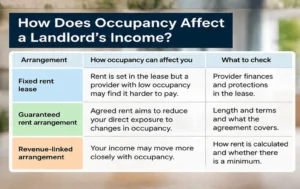
The effect depends on how your agreement is written. The table below shows the general picture for three common arrangements. Terms vary so always check your own documents.
| Arrangement | How occupancy can affect you | What to check |
|---|---|---|
| Fixed rent lease | Rent is set in the lease but a provider with low occupancy may find it harder to pay | Provider finances and protections in the lease |
| Guaranteed rent arrangement | Agreed rent aims to reduce your direct exposure to changes in occupancy | Length and terms and what the agreement covers |
| Revenue-linked arrangement | Your income may move more closely with occupancy | How rent is calculated and whether there is a minimum |
No arrangement removes every risk. A fixed rent only helps you if the provider can keep paying it. That is why the provider and the lease matter as much as the building. Our guide to the care property lease explains the common structures in more detail.

What Makes a Property Suitable for a Provider?
Demand only turns into occupancy if the building works for the people who will live there. A house that suits a family does not always suit residents who need support. Providers usually look at:
- Layout. Enough bedrooms of a suitable size plus communal and staff space
- Access. Safe routes through the building and step-free access where needed
- Outdoor space. Safe and usable areas that suit the residents
- Parking. Room for staff and visiting professionals
- Location. Links to transport and services and the likely effect on neighbours
- Condition. Structure and electrics and heating and any works already needed
Different care types have different needs. A building that works for supported living may not suit a registered children’s home. If a house needs changes first our article on C2 care home conversion explains what is usually involved.
Fire safety matters here too. A provider will not want to fill a building that cannot meet its duties. The government publishes guidance on fire safety risk assessment for residential care premises. It is aimed mainly at settings where many residents would need help to reach safety so check which guidance fits your property. Our guide to care home fire safety covers the main measures.
How Do Planning and Use Class Affect Demand?
A property must be lawful for the use before it can be filled. Every building in England has a planning use class set out in the Use Classes Order 1987. A standard home sits in C3. A small group living together as a single household with care provided can fall under C3(b). Larger or more institutional care settings usually fall under C2.
A property that already has the right permission is often easier for a provider to take on. A property that needs a change of use adds time and uncertainty. In most cases moving a normal dwelling into a C2 use needs planning permission and councils can take different views. The government’s guidance on when permission is required is a good starting point.
For more detail read our guides to the C2 use class and C2 planning permission. Remember that planning is separate from registration. Children’s homes must be registered with Ofsted and adult care homes in England are regulated by the Care Quality Commission.
How Do You Assess Occupancy and Demand? (Step by Step)
Use this sequence when you review a property or a provider.
- Define the care type. Decide whether the property suits residential care or children’s care or supported living.
- Research local need. Speak to local commissioners and providers and read the council’s published plans.
- Check the provider’s record. Review inspection reports and registration status and how long they have operated.
- Ask about occupancy history. Request the pattern over time and the reasons for any gaps.
- Review the provider’s finances. Look at accounts through Companies House and ask your accountant to interpret them.
- Test the building. Confirm layout and access and compliance fit the planned residents.
- Read the agreement. Have a solicitor check how rent is set and what happens if places stay empty.
- Plan for change. Consider who else could use the property if the first provider left.
For children’s homes you can read inspection outcomes on the Ofsted reports site. Treat what you find as one input and not a verdict.
What Should You Check in the Lease?
The lease decides who carries the risk when places are empty. Read it closely and ask your solicitor to explain anything unclear. Key points include:
- Length of the term and any break clauses
- How rent is set and reviewed
- Who pays for repairs and insurance
- What happens if the provider loses registration
- What happens at the end of the term
- Whether there are protections if the provider struggles financially
If you are comparing options our guide to a residential care home for lease explains what providers look for and how arrangements are commonly structured. Never sign until the terms have been reviewed by someone with specialist property experience.
How Can Guaranteed Rent Help With Occupancy Risk?
Many landlords want income that does not rise and fall with every change in a home’s occupancy. This is where guaranteed rent can help. With guaranteed rent a landlord receives an agreed and reliable rental income rather than depending on one tenant’s circumstances. The aim is to reduce uncertainty from void periods and day-to-day management.
Prem Property is a Birmingham-based guaranteed rent and property management provider specialising in social and specialised housing. Its guaranteed rent solutions and professional property management support landlords with maintenance coordination and compliance support and ongoing property care. It also helps housing providers access suitable properties across the Midlands and Greater London.
Terms differ between providers so read every agreement carefully. No arrangement removes all risk and nobody can promise outcomes. Make sure the property is permitted and compliant before you agree to anything.
Is Care Property a Long-Term Strategy?
For some landlords it is. Care property tends to involve longer relationships with specialist providers than a standard let. That can suit owners who prefer stability over frequent tenant changes. It also asks for more homework at the start and more care over the provider and the agreement.
If you are weighing it against other routes our guides to C2 property investment and specialist supported housing investment explain the options and the risks. You can also read how real projects have worked in our care property case studies.
What Mistakes Do Landlords Make About Occupancy?
Treating one figure as proof. A single snapshot can mislead. Look at the trend and the reasons.
Assuming demand is the same everywhere. Need and commissioning vary widely by area and by care type.
Ignoring the provider. Occupancy reflects how well the service is run so the provider’s record matters.
Focusing on the building alone. A lovely property still needs a provider who can fill it and pay for it.
Skipping the lease detail. Terms decide who carries the risk when places are empty.
Confusing planning with registration. Planning permission and building regulations and fire safety and registration are separate requirements.
Expecting guaranteed outcomes. Be wary of anyone who promises fixed results before they have seen your property.
When Should You Get Professional Advice?
Earlier than you think. Speak to a qualified professional before you commit to a purchase or a lease. A solicitor can review the agreement and a planning consultant can confirm the use class and the planning route. A surveyor can assess the building and a competent fire risk assessor can review fire safety. An accountant or financial adviser can help you understand the provider’s accounts and your own position. The Planning Portal is a helpful official starting point for planning questions.
Key Takeaways
- Care home occupancy shows how many of a home’s places are filled and it is one useful health check on a provider.
- Demand depends on local need and commissioning and funding and quality and property standards.
- Your income depends on the lease and the provider as well as the building.
- A property must be lawful and suitable before it can be filled.
- Use classes (C3 and C3(b) and C2) shape the planning route.
- Adult care homes are regulated by the CQC and children’s homes by Ofsted.
- Guaranteed rent can reduce uncertainty but never removes all risk.

Frequently Asked Questions
What is care home occupancy?
It is the share of a home’s available places that are currently filled. It changes over time as residents arrive and leave.
Does low occupancy mean a care home is failing?
Not necessarily. A new home may be filling steadily and a home may have gaps for many reasons. Look at the trend and the provider’s explanation.
Does occupancy affect the rent I receive?
It depends on your agreement. Some arrangements fix the rent while others link it more closely to the service. Read the terms carefully and ask your solicitor to explain them.
How can I find out about demand in my area?
Speak to local commissioners and care providers and read your council’s published plans. Treat any single source with caution and compare several views.
Is planning permission enough to fill a care home?
No. Planning decides whether the use is lawful. Building regulations and fire safety and registration with the CQC or Ofsted are separate. The provider must also attract and keep residents.
Can guaranteed rent protect me from empty places?
Guaranteed rent aims to reduce your direct exposure to changes in occupancy. The details depend on the agreement so read it carefully and take legal advice.
Final Thoughts
Care home occupancy is a useful signal but it is only one piece of the picture. Strong demand and a suitable building and a capable provider and a well-drafted agreement need to come together. Check each of them and keep records of what you find.
Take your time and use the right professionals. If you own a suitable property in Birmingham or the wider West Midlands or Greater London you can speak to Prem Property about guaranteed rent solutions and how professional property management could support your plans.