
Children’s home regulations in England are governed primarily by the Children’s Homes (England) Regulations 2015, setting out the legal standards every registered home must meet. These rules cover everything from staffing ratios and safeguarding to premises quality and record-keeping, and failing to meet them can result in enforcement action or closure.
Key Takeaways
- Children’s homes in England must be registered with Ofsted before they can operate, and registration can be refused or withdrawn.
- The Children’s Homes (England) Regulations 2015 set binding standards across welfare, premises, staffing, and leadership.
- Ofsted inspections are unannounced and graded; an “Inadequate” rating carries serious legal consequences.
- Property investors must consider planning use class, building standards, and regulatory fitness before purchasing or converting a site.
- Running a children’s home can generate strong, long-term income, but the compliance burden is significant and must be factored into your investment model.
- Fire safety, spatial standards, and accessibility requirements are non-negotiable physical features of any compliant property.
Why Children’s Home Regulations Exist and Who They Apply To
The regulatory framework around children’s homes exists because the young people placed in them are among the most vulnerable in society. Many have experienced neglect, abuse, or trauma, and the state has a legal duty of care towards them under the Children Act 1989 and the Care Standards Act 2000.
In England, the Care Quality Commission oversees adult care services, but children’s homes fall under a separate regime entirely, regulated by Ofsted. Any setting that provides accommodation and care for children under 18 on a regular basis, other than schools or hospitals, is likely to require registration as a children’s home under the Care Standards Act 2000.
This applies regardless of size. A property housing just one child, if it is operated as a regulated placement, still falls within scope. Many investors are surprised by this, particularly those coming from the adult care sector, where different thresholds apply.
The Children’s Homes (England) Regulations 2015: What They Actually Require
The 2015 Regulations, alongside the Quality Standards for Children’s Homes, sit at the heart of children’s home regulations in England. They define nine quality standards that every home must meet consistently.
These are:
- The children’s welfare standard: Every decision must prioritise the welfare and individual needs of the child.
- The wishes and feelings standard: Children must be able to express their views, and those views must be considered.
- The safeguarding standard: Homes must have robust procedures for protecting children from harm, abuse, and exploitation.
- The health and well-being standard: Physical and mental health needs must be assessed and met.
- The education standard: Children must be supported to access appropriate education and training.
- The enjoyment and achievement standard: Children must have opportunities for leisure, recreation, and development.
- The positive relationships standard: Staff must support children in forming and maintaining healthy relationships.
- The care planning standard: Each child must have an individual, up-to-date care plan reviewed regularly.
- The leadership and management standard: Registered managers must demonstrate strong governance and oversight.
These standards are not aspirational. They are legally binding, and Ofsted assesses performance against each one. If you are thinking about investing in this sector, reading the full guidance on ofsted childrens homes regulations inspections and what investors need to know is an essential starting point before you commit any capital.
Premises Requirements: What the Building Must Provide
Physical standards are one area where children’s home regulations directly affect property investors. The building itself must be suitable, and suitability is assessed during the Ofsted registration process and at every subsequent inspection.
Key premises requirements include:
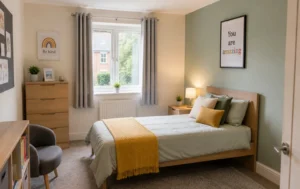
- Sufficient bedrooms: Each child must have their own bedroom of adequate size. Shared rooms are generally not acceptable under current standards.
- Communal space: There must be appropriate living areas, a dining space, and outdoor areas where possible.
- Safe environment: Properties must be free from hazards and meet health and safety legislation.
- Fire safety: Homes must comply with the Regulatory Reform (Fire Safety) Order 2005. This means a documented fire risk assessment, appropriate detection and suppression systems, and clear evacuation procedures. Our article on home fire safety covers the key physical requirements in more detail.
- Privacy and dignity: Bathrooms and toilets must be adequate in number and allow for privacy.
- Accessibility: Where children with physical disabilities are placed, the property must be appropriately adapted.
One practical point worth flagging: many older properties that investors consider converting simply do not have the room layouts or ceiling heights to meet these standards without significant structural work. Always commission a professional survey before purchase.
Planning Use Class and the C2 Designation
Children’s homes typically fall within Use Class C2 under the Town and Country Planning (Use Classes) Order 1987, which covers residential institutions. This is a separate planning category from standard residential (C3), and you cannot simply purchase a family home and begin operating a children’s care home without obtaining planning permission for change of use.
Local planning authorities assess applications for C2 use against several criteria, including the impact on the local area, parking, and the appropriateness of the building. Permitted development rights do not generally allow a C3 residential property to become a C2 care home without consent.
This planning complexity catches a number of first-time investors off guard. If you want to understand the planning and investment landscape more thoroughly, the article on c2 residential care home what investors and developers need to know provides a useful breakdown of the process and the considerations involved.
Understanding the full investment picture, from acquisition through to compliance, is also covered in our residential childrens homes a guide for investors, which sets out the financial and operational factors alongside the regulatory ones.
Ofsted Registration: The Process and the Timelines
Before a children’s home can accept any placements, it must be registered with Ofsted. The registration process is lengthy and detailed, and there is no shortcut through it.
The process involves:
- Submitting an application that includes details of the responsible individual, the registered manager, the statement of purpose, and the policies and procedures for the home.
- Ofsted carrying out an inspection of the premises.
- An interview with the proposed registered manager to assess their suitability.
- Enhanced DBS checks for all staff and managers.
- Ofsted making a registration decision, which can include conditions, refusal, or approval.
The full process typically takes between four and six months, and in practice it often runs longer if documentation is incomplete or if the premises raise concerns. Ofsted’s guidance on children’s home registration sets out the precise requirements and the forms you will need to submit.
One area investors should budget carefully for is the period between property completion and first placement. There is often a gap of several months during which the property is generating no income, but mortgage payments, insurance, and set-up costs continue. Building this into your financial model is essential.
Ongoing Inspection and Enforcement
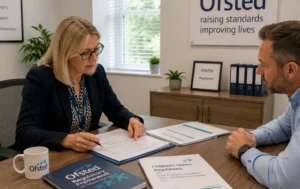
Once registered, a children’s home is subject to Ofsted inspections. These are unannounced and can happen at any time. Homes are graded across four categories: Outstanding, Good, Requires Improvement, and Inadequate.
An “Inadequate” judgement carries serious consequences. Ofsted can issue a compliance notice, restrict the home’s operations, or in the most serious cases move to cancel registration entirely. According to Ofsted’s annual children’s social care statistics, a meaningful proportion of homes inspected each year are rated as Requires Improvement or Inadequate, which underlines how demanding the standards are to maintain consistently.
Enforcement action by Ofsted is not a distant theoretical risk. It happens regularly, and investors with lease agreements or income-dependent financing tied to the home’s operation need to understand how quickly income can be disrupted if a placement restriction is imposed.
Staffing Ratios, Registered Managers and Your Legal Obligations
Children’s home regulations place specific requirements on staffing. Every home must have a registered manager who holds the appropriate qualification (typically a Level 5 Diploma in Leadership for Health and Social Care and Children and Young People’s Services) and who is deemed fit by Ofsted.
Staffing ratios are not rigidly prescribed by a single number in the regulations, but homes are expected to maintain sufficient, competent staff to meet the needs of the children at all times, including overnight. In practice, this means most homes run staffing at levels that represent a significant cost base, often £300,000 to £500,000 per year for a small four- or five-bed home when you account for waking nights, bank staff, and management.
This cost structure is one reason why understanding rental property management principles matters even in specialist sectors like this. Whether you operate the home yourself or lease the property to an operating provider, understanding how costs are structured and what drives profitability shapes whether the investment makes financial sense.
Financial Modelling: What Investors Need to Know
Weekly placement fees for children in residential care in England vary considerably. A standard placement at a small, good-rated home in 2024 typically runs between £4,000 and £7,000 per child per week, with specialist provision for children with complex needs commanding higher fees. These are funded by local authorities under their duty to provide suitable care for looked-after children.
| Home Size | Weekly Fee Range (per child) | Annual Gross Revenue (est.) | Typical Property Value |
|---|---|---|---|
| 2-bed home | £4,000 to £5,500 | £400,000 to £550,000 | £350,000 to £550,000 |
| 4-bed home | £4,500 to £6,500 | £900,000 to £1.3m | £500,000 to £900,000 |
| 5-bed home | £5,000 to £7,000 | £1.25m to £1.75m | £600,000 to £1.1m |
Revenue figures assume full occupancy, which is not always achieved, particularly in the first year. Factors affecting occupancy include Ofsted grade, location, and the home’s specialism.
For more resources across specialist property investment topics, the blogs section covers a range of subjects relevant to this market.

Things to Know
- Ofsted registration is required before a single child can be placed. Operating without registration is a criminal offence under the Care Standards Act 2000.
- The registered manager is personally accountable to Ofsted and must meet specific qualification requirements.
- Planning permission for C2 use is a separate process from Ofsted registration, and both must be obtained.
- Not all local authorities commission placements in all areas. Location matters significantly for occupancy.
- Lease agreements between property investors and operating companies are largely unregulated, so independent legal advice is essential before signing.
- The BBC has reported extensively on the shortage of children’s home placements in England, which supports demand in the sector but also increases regulatory scrutiny.
Ready to Move Forward With a Children’s Home Investment?
The single most useful next step you can take right now is to commission an independent feasibility assessment covering planning, building suitability, and a realistic financial model for your chosen area. Do this before purchasing a property, not after. Engaging a solicitor with social care property experience and speaking to an Ofsted pre-registration adviser will save you months of costly mistakes.
Frequently Asked Questions
Q: Do all children’s homes in England need to be registered with Ofsted?
Yes, every children’s home in England providing regulated care and accommodation for children under 18 must be registered with Ofsted before accepting placements.
Registration is a legal requirement under the Care Standards Act 2000. Operating without registration is a criminal offence and can result in prosecution, regardless of the size of the home or the number of children placed.
Q: How long does it take to get Ofsted registration for a children’s home?
The process typically takes between four and six months, though it often takes longer if documentation is incomplete or the premises require further assessment.
Investors should factor this timeline into their financial planning, as no income can be generated during the registration period. Delays are common, particularly for first-time applicants.
Q: What qualifications does a registered manager need to run a children’s home?
A registered manager is generally required to hold a Level 5 Diploma in Leadership for Health and Social Care and Children and Young People’s Services, or to work towards it within a set timeframe.
Ofsted assesses the manager’s suitability as part of the registration process. The manager’s experience, character, and understanding of safeguarding are all evaluated directly.
Q: What happens if a children’s home receives an “Inadequate” Ofsted rating?
An “Inadequate” rating triggers a formal compliance process, which can include placement restrictions, a compliance notice, or in serious cases, cancellation of registration.
This directly affects the home’s revenue and can create significant difficulties for investors with lease-based income models. Understanding this risk is essential before investing.
Q: Can I convert a standard residential property into a children’s home?
Yes, but you will need planning permission for a change of use from Class C3 (residential) to Class C2 (residential institution), which is separate from the Ofsted registration process.
The building must also meet specific premises requirements set out under children’s home regulations before Ofsted will approve registration. Many properties require structural or layout changes to comply.
The Bottom Line on Children’s Home Regulations
Children’s home regulations represent one of the most demanding compliance frameworks in the UK property sector, but they exist for a very good reason: the protection of vulnerable young people. For property investors, this means the barrier to entry is high, the due diligence process is lengthy, and the ongoing management responsibilities are substantial.
That said, the investment case is real. Demand for quality, well-regulated children’s home placements in England significantly outstrips supply, and the combination of long-term leases and high weekly placement fees can generate strong, sustained returns. The key is going in with a clear understanding of the regulatory environment, not treating it as an afterthought. If you are serious about this sector, start with the regulations, build backwards to the property, and never underestimate the time and cost of compliance.