

A C2 property is a building that falls under the C2 use class within England’s planning system, covering residential institutions such as care homes, nursing homes, residential schools, and children’s homes. Understanding what a C2 property is is essential for anyone looking to develop, lease, or invest in specialist accommodation in the UK.
Key Takeaways
- C2 is a planning use class in England covering residential institutions, including care homes, nursing homes, and children’s homes.
- Converting a property to C2 use typically requires planning permission from the local planning authority.
- C2 properties carry additional regulatory obligations beyond standard residential use, including fire safety, accessibility, and care-sector compliance.
- Landlords and investors can access reliable income through specialist providers who operate within the C2 sector.
- Prem Property, based in Birmingham, supports landlords and providers navigating the C2 market across the Midlands and Greater London.
- Properties within the C2 use class are in growing demand as the UK population ages and the need for specialist care accommodation rises.
The UK planning system can feel complicated at first glance, but understanding use classes is a vital step for anyone working in property, care provision, or specialist housing. The C2 designation is one that landlords, investors, and care operators encounter regularly, yet it is often misunderstood or overlooked until it becomes a regulatory issue. This article breaks down what C2 planning use actually means, who it applies to, and why it has become increasingly relevant in the specialist housing market.
What the C2 Use Class Actually Covers
The C2 use class sits within the Town and Country Planning (Use Classes) Order 1987, as amended. It applies to residential institutions rather than ordinary dwelling houses, which fall under C3. The distinction matters enormously in practice, because a building operating as a care home or children’s home without the correct planning use class in place is technically in breach of planning law.
The categories that typically fall under C2 include:
- Residential care homes and nursing homes
- Children’s homes registered with Ofsted
- Residential schools and colleges
- Training centres with residential accommodation
- Hospitals (in some circumstances)
It is worth distinguishing C2 from C2A, which covers secure residential institutions such as prisons and detention centres. These are two separate designations with very different implications.
For anyone exploring a residential care home for lease, understanding which use class the building currently holds is one of the first practical steps. A property used as a standard family home carries C3 use class, and switching it to operate as a care home requires a formal application for change of use to the local planning authority (LPA).
According to guidance published by the Planning Portal, change of use applications can involve considerable scrutiny, particularly when the proposed use will increase vehicle movements, noise, or the number of people on site.
Why Planning Use Class Matters Beyond the Paperwork
Some people assume that obtaining the correct use class is simply a box-ticking exercise. In reality, it carries significant practical consequences. Operating a care home under C3 residential use rather than C2 can expose both the landlord and the operator to enforcement action from the local council, invalidation of business insurance, and difficulties obtaining or retaining registration with the Care Quality Commission (CQC).
The Care Quality Commission regulates adult social care services in England and requires providers to meet specific premises standards. While the CQC does not itself issue planning permission, inspectors will take a dim view of premises that do not have appropriate legal consent for their use.
For operators running children’s homes, Ofsted plays a comparable role. Any operator seeking to understand care home requirements will quickly discover that the regulatory framework involves multiple overlapping bodies, from the LPA to the CQC or Ofsted, plus fire safety authorities and building control.
Converting a Standard Property to C2 Use
One of the most common questions from property investors and landlords is whether an existing residential or commercial building can be converted to C2 use. The short answer is yes, but the process is rarely straightforward.
Key considerations when applying for a change of use to C2 include:
- Location and neighbouring uses: LPAs will assess whether a care home or children’s home is appropriate in the proposed location. Proximity to schools, community facilities, and transport links can influence the decision.
- Building suitability: The property must meet minimum space standards, accessibility requirements, and fire safety regulations. Older Victorian terraced houses, for example, often require substantial structural work to satisfy these standards.
- Parking and access: Increased staff movements, visitor access, and potential ambulance or support vehicle access must be accounted for.
- Noise and disturbance: Neighbouring residents may raise objections, particularly for children’s homes. LPAs must weigh these against the social need for the facility.
Investors considering a care property lease arrangement should also factor in whether the current planning consent is in place before signing any heads of terms. Taking on a lease for a property without confirmed C2 use places unnecessary risk on the operator.
The NHS guidance on healthcare premises and the GOV.UK planning practice guidance both provide useful reference points for understanding when planning permission is required and what the application process involves.
The Investment Case for C2 Properties
Beyond the regulatory framework, there is a compelling investment narrative around C2 properties. The UK has an ageing population, with ONS data on population projections indicating consistent growth in the over-65 and over-85 age groups. This demographic shift is driving sustained demand for residential care beds, nursing home places, and supported living accommodation.
For landlords, this creates a situation where specialist providers are actively seeking suitable properties, often on long leases with institutional-grade covenants. A care home operator with CQC registration represents a very different tenant profile compared with a private individual renting a flat, and many landlords find the longer lease terms and professional management arrangements appealing.
The growing demand for specialist housing solutions across England reflects this shift, and it is one of the reasons why companies like Prem Property have built their entire service model around connecting landlords with specialist providers in this space.

How Prem Property Works Within the C2 Sector
Prem Property was founded in May 2019 with a clear focus on making the social and specialised housing sector more accessible across the Midlands and Greater London. Based in Birmingham, the company works with landlords who want reliable, long-term income and with providers who need access to suitable properties to deliver care and support services.
For landlords, this means guaranteed rental income, professional property management, and reduced exposure to the void periods and tenant issues that come with conventional residential letting. For providers, it means access to a curated network of properties that are either already operating with C2 use or are suitable candidates for conversion.
The company understands the practicalities that come with what a C2 property means in real-world terms: the fire safety requirements, the Ofsted and CQC considerations, the building standards, and the planning process. This knowledge makes Prem Property a useful partner for landlords and investors who are new to the specialist sector or looking to expand their portfolios.
Landlords interested in seeing how these arrangements work in practice can explore the blogs on the Prem Property website, which cover topics from guaranteed rent solutions to care home property procurement.
For those specifically looking at opportunities in the West Midlands, Prem Property’s work across the region includes sourcing suitable properties for care operators. The growing need for a residential care home in Birmingham reflects the wider national picture: urban centres with ageing populations and active health and social care ecosystems generate consistent demand for C2 accommodation.
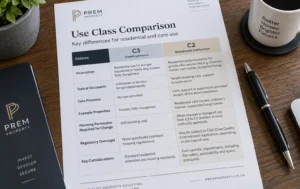
Key Differences Between C2 and Other Residential Use Classes
Understanding C2 is easier when it is placed alongside the other residential use classes in the planning system.
| Use Class | Description | Typical Examples |
|---|---|---|
| C1 | Hotels and guest houses | Hotels, boarding houses |
| C2 | Residential institutions | Care homes, nursing homes, children’s homes |
| C2A | Secure residential institutions | Prisons, young offender institutions |
| C3 | Dwellinghouses | Family homes, flats, HMOs (some) |
| C4 | Houses in multiple occupation | Small shared houses (3–6 unrelated people) |
The gap between C3 and C2 is where most practical confusion arises. A property that looks like a large family home could be operating legally under C3 or could require C2 if it is being used as a care home. The use, not the building type, determines the class.
Practical Steps for Landlords and Investors Considering C2
If a landlord or investor is considering whether to pursue a C2 property opportunity, a structured approach reduces the risk of costly mistakes.
- Check the existing use class with the local planning authority before making any financial commitment.
- Instruct a planning consultant who has experience with residential institution applications, not just general permitted development.
- Engage a specialist operator early to understand what building specifications they require, as these will shape the scope and cost of any conversion works.
- Review fire safety requirements under the Regulatory Reform (Fire Safety) Order 2005, which applies to premises of this type.
- Understand the lease structure that a specialist provider will expect, including length, rent review mechanisms, and repairing obligations.
- Seek specialist property management support to ensure ongoing compliance once the property is operational.
For investors researching the Guardian’s coverage of care sector housing or BBC reporting on care home supply pressures, the picture that emerges is consistent: the supply of suitable premises is a persistent challenge across England, and well-prepared landlords are well placed to fill that gap.
Regulatory Compliance After Planning Is Secured
Securing C2 planning consent is the beginning, not the end, of the compliance journey. Once a property is operating under C2 use, the landlord and operator must maintain ongoing adherence to a range of requirements.
These include:
- Annual fire risk assessments under the Health and Safety Executive’s fire safety guidance
- CQC registration and inspections for adult care services
- Ofsted registration for children’s homes, including Ofsted inspections
- Building control compliance for any ongoing works
- Environmental health requirements for communal living spaces
Landlords who partner with experienced providers and specialist property managers can navigate these obligations more efficiently. Prem Property’s approach of offering professional property management alongside guaranteed rent solutions means that compliance responsibilities are shared rather than left entirely to landlords who may be unfamiliar with the care sector’s specific demands.
The Bottom Line on What a C2 Property Is
Understanding what a C2 property is goes beyond memorising a planning use class definition. It means understanding the intersection of planning law, care regulation, building standards, and investment strategy that makes C2 properties both complex and commercially attractive.
For landlords sitting on suitable larger properties, the C2 sector offers long leases, professional tenants, and stable income. For providers, it offers accommodation that meets the standards needed to deliver regulated care. For communities, it means better-quality specialist housing for vulnerable people who need consistent, safe environments.
Prem Property continues to support landlords, investors, and care providers across the Midlands and Greater London in navigating this space. Whether a landlord is exploring their first specialist letting or an operator is looking to expand their estate, getting the right property partner in place from the outset makes the process significantly more straightforward.
Things to Know
- C2 use class is distinct from C3 (standard residential), meaning a landlord cannot simply begin operating a care home in an ordinary family house without first obtaining planning permission for change of use.
- Not all large or converted properties will automatically be granted C2 consent. Local planning authorities assess each application individually, and refusals do happen, particularly in areas where local residents raise objections.
- Some properties may already hold historic C2 planning consent from a previous use, such as a former nursing home or boarding school. Checking the planning history of a building before purchase can save significant time and cost.
- The C2 use class does not automatically confer the right to operate a regulated care service. CQC registration (for adult care) or Ofsted registration (for children’s homes) must be obtained separately and maintained independently of planning consent.
- Landlords leasing to C2 operators should ensure their mortgage lender and buildings insurer are both informed and have consented to the specialist use, as standard residential policies rarely cover institutional occupation.
- Permitted development rights are generally more restricted for C2 properties than for standard C3 dwellings, meaning that alterations and extensions are more likely to require full planning permission rather than falling under permitted development.
Find Out Whether Your Property Could Work as a C2 Specialist Home
The demand for quality C2 properties across the Midlands and Greater London is real, and landlords with suitable buildings should not wait to explore their options. Prem Property connects landlords with vetted specialist providers, handles professional property management, and delivers guaranteed rental income, all without the day-to-day stress of conventional letting. Whether a landlord has a large residential property sitting underused or an investor is actively searching for the right specialist opportunity, Prem Property’s expertise in the social and specialised housing sector makes the process far more accessible.
Reach out to Prem Property today to find out whether your property could be the right fit for a specialist care or supported living provider.
Frequently Asked Questions
Q: Do I need planning permission to convert a house into a care home under C2 use?
Yes, in almost all cases a formal change of use application is required to convert a standard residential property to C2 use.
A property used as a family home sits under the C3 use class, and operating it as a care home without C2 consent is a breach of planning law. The application is submitted to the local planning authority, who will assess the proposal against local planning policy, neighbouring uses, access requirements, and the building’s physical suitability. It is advisable to instruct a planning consultant with experience in residential institution applications before proceeding.
Q: What is the difference between a C2 and a C3 property?
C2 covers residential institutions such as care homes and children’s homes, while C3 covers ordinary dwellinghouses, including family homes and most privately rented flats.
The key distinction is the nature of the use rather than the physical appearance of the building. A large detached house could physically resemble a care home but legally remain C3 unless a change of use has been granted. This distinction has significant practical consequences for planning compliance, insurance, mortgage conditions, and regulatory registration with bodies such as the CQC or Ofsted.
Q: Can a landlord earn guaranteed rent from a C2 property?
Yes, and many landlords find that leasing to specialist care or supported living providers offers more stable long-term income than conventional residential letting.
Specialist operators typically require longer leases, often five years or more, and they operate as professional institutional tenants rather than private individuals. This reduces the risk of void periods and tenant-related issues that are common in the standard lettings market. Companies like Prem Property facilitate these arrangements by connecting landlords with suitable providers and structuring guaranteed rent solutions that give landlords financial certainty throughout the lease term.
Q: How long does a C2 planning application typically take to be decided?
A standard change of use application to C2 should, in theory, be determined within eight weeks, though complex or contested applications can take considerably longer.
Local planning authorities are required to decide most applications within eight weeks under national planning regulations, but this timeline is not always met in practice. Applications involving significant neighbour objections, listed buildings, or sites in conservation areas may require extended consultation periods. Applicants should build a realistic timeline into their project planning and seek pre-application advice from the LPA wherever possible, as this can reduce the risk of unexpected delays or outright refusal.
Q: Is a children’s home the same as a C2 property?
A registered children’s home typically requires C2 planning use, but the planning classification is only one part of the compliance picture.
Children’s homes in England must be registered with, and regularly inspected by, Ofsted, independently of any planning consent the building holds. The property itself must also meet specific standards around space, fire safety, accessibility, and building condition. Operators and landlords working in this area should be aware that Ofsted’s registration requirements and the local planning authority’s planning requirements run in parallel, and neither automatically satisfies the other. Seeking specialist advice from a property partner with experience in this sector, such as Prem Property, helps landlords and operators avoid gaps in compliance.
Where to Go From Here With What a C2 Property Is
Getting to grips with C2 planning use is an important first step, but the real value comes from acting on that understanding. Whether a landlord is assessing a property for the first time or an investor is building a specialist portfolio, the combination of correct planning consent, regulatory compliance, and the right provider partnership is what makes a C2 property work effectively over the long term.
Prem Property’s expertise across the Midlands and Greater London means that landlords and providers do not have to navigate this sector alone. Reaching out to the team is the most direct way to find out whether a specific property is suitable, what income it could generate, and how a specialist housing partnership could be structured to benefit everyone involved.