
A full repairing and insuring lease (FRI) makes the tenant responsible for all repair, maintenance and insurance costs, offering landlords a predictable income. In contrast, an Internal Repairing and Insuring (IRI) lease splits these responsibilities, with the landlord typically covering external and structural elements.
Choosing the right lease agreement is one of the most critical decisions you will make as a landlord of a care property. The terms you agree will define your responsibilities, financial exposure and the overall return on your investment for years to come. Understanding the difference between a full repairing and insuring lease and an Internal Repairing and Insuring (IRI) lease is fundamental to making an informed decision. This guide explores both structures from the perspective of a C2 care property landlord.
This article provides general guidance for informational purposes and does not constitute legal, financial, planning or fire safety advice. You should always consult with a qualified solicitor and other relevant professionals before entering into any lease agreement.
Understanding Commercial Lease Structures for Care Properties
When you let a property to a care provider, the lease is more than just a rental agreement. It is a detailed legal document that dictates the relationship between you and your tenant. The two most common structures in UK commercial property are the full repairing and insuring lease (often called an FRI lease) and the Internal Repairing and Insuring (IRI) lease. The primary difference between them lies in how they divide the obligations for property repairs, maintenance and insurance. This division has a direct impact on your level of risk, your management responsibilities and the predictability of your rental income. For a comprehensive overview, see our a guide to care property leases.
What Is a Full Repairing and Insuring (FRI) Lease?
A full repairing and insuring lease is a type of lease where the tenant is responsible for all costs associated with the repair, maintenance and insurance of the entire property. This structure is often preferred by landlords of single-let commercial properties as it provides a clear and predictable income stream with minimal deductions.
Tenant’s Obligations Under an FRI Lease
Under a typical FRI lease, the tenant’s repairing obligations are extensive. They are generally required to keep the property in good repair and condition. This responsibility usually covers everything from the roof to the foundations, including:
- All internal and non-structural parts of the building.
- External elements such as walls, windows and doors.
- Structural parts of the property like foundations and load-bearing walls.
- Arranging and paying for the building’s insurance policy.
The tenant’s liability is significant, which is why vetting a prospective care provider is absolutely essential before agreeing to a full repairing and insuring lease.
Landlord’s Obligations Under an FRI Lease
The landlord’s obligations are minimal under a full repairing and insuring lease. In most cases, the landlord’s primary role is simply to collect the rent. They typically have no responsibility for repairing or insuring the building. Exceptions may arise if the lease explicitly excludes certain structural elements from the tenant’s duties or in a multi-let building where the landlord manages and recharges costs for common areas.
What Is an Internal Repairing and Insuring (IRI) Lease?
An Internal Repairing and Insuring lease or IRI lease, creates a split in responsibilities. It is a more common arrangement in multi-occupied buildings where it would be impractical for a single tenant to be responsible for the entire structure. However, it can also be used for single-let properties.
Tenant’s Obligations Under an IRI Lease
With an internal repairing and insuring lease, the tenant is typically only responsible for the interior of the specific area they occupy (often referred to as the ‘demise’). This usually includes non-structural elements such as internal walls, floor coverings and fixtures and fittings. The exact scope will be defined in the lease agreement.
Landlord’s Obligations Under an IRI Lease
Under an IRI lease, the landlord retains responsibility for the external and structural parts of the building. This includes the roof, foundations and main walls. The landlord is also responsible for arranging the building’s insurance. These costs are then typically recovered from the tenant through a service charge. This structure involves more hands-on management and financial administration for the landlord.

FRI vs IRI Leases Key Differences for Care Property Landlords
Choosing between a full repairing and insuring lease and an IRI lease requires a clear understanding of their differences. The right choice depends on your property, your tenant and your appetite for risk and management.
| Feature | Full Repairing and Insuring (FRI) Lease | Internal Repairing and Insuring (IRI) Lease |
|---|---|---|
| Responsibility for Repairs | Tenant is responsible for all repairs including internal, external and structural. | Tenant is responsible for internal repairs only. Landlord handles external and structural repairs. |
| Financial Risk | Lower and more predictable for the landlord. The tenant bears the risk of unexpected repair costs. | Higher for the landlord who may face large, unbudgeted repair bills (though often recoverable via service charge). |
| Insurance Administration | Tenant arranges and pays for the building’s insurance directly. | Landlord arranges insurance and recharges the premium to the tenant, often through a service charge. |
| Rental Value | The rent may be slightly lower to reflect the significant liabilities the tenant is taking on. | The rent may be slightly higher as the landlord retains more risk and responsibility. |
Understanding the full scope of landlord responsibilities in a care home lease is crucial regardless of the structure you choose. While a full repairing and insuring lease minimises your duties, certain statutory obligations may remain.
Specific Considerations for C2 Use Class Properties
Leasing to a care provider for a C2 use class property introduces unique factors that influence the choice between an FRI and IRI lease. A C2 property is defined under The Town and Country Planning (Use Classes) Order 1987 as a residential institution, such as a care home. This is distinct from a standard C3 dwellinghouse or C3(b) property for up to six residents receiving care. Understanding what is a C2 property? is the first step.
Tenant Profile and Covenant Strength
The financial stability of your tenant, known as their covenant strength, is paramount with a full repairing and insuring lease. You are relying on them to fund potentially expensive repairs. Before signing, you must perform thorough due diligence on a care provider tenant. This includes checking their financial history via the Companies House service and reviewing their track record. For children’s homes, you can search Ofsted inspection reports to assess their operational quality.
Property Condition and Age
The age and condition of your property are significant. An older building, perhaps in an area like Birmingham or Greater London, may carry a higher risk of needing major structural work. In such cases, a tenant may be reluctant to accept a full repairing and insuring lease without a very detailed Schedule of Condition or a lower rent. It is vital to understand the UK care home property requirements your building must meet.
Regulatory Compliance (CQC and Ofsted)
Care properties must meet strict physical standards set by regulators. For adult care, this is the Care Quality Commission (CQC) in England. For children’s homes, it is Ofsted. The lease must be crystal clear on who is responsible for carrying out and funding any works required to meet or maintain these standards, including those related to fire safety as outlined in The Regulatory Reform (Fire Safety) Order 2005. Understanding how CQC inspections affect your lease is essential. Landlords should also be aware of Ofsted guidance on registering a children’s home, which details property requirements. The lease must assign responsibility for compliance with planning rules and Building regulations approval guidance.
The Importance of a Schedule of Condition
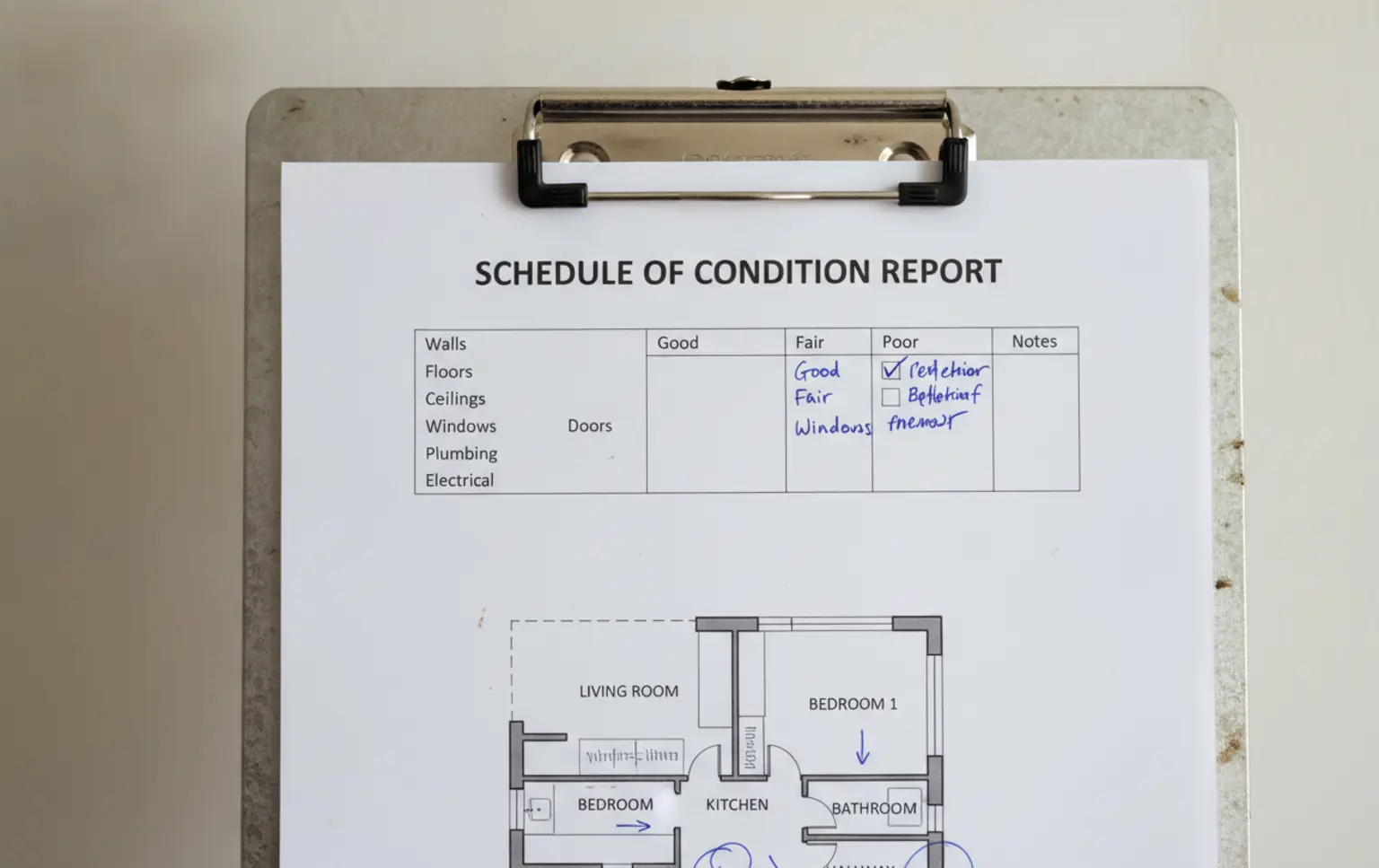
A Schedule of Condition is a factual report, often prepared by a surveyor, that documents the state of a property at the beginning of a lease. It usually includes detailed descriptions and photographs. Its purpose is to limit the tenant’s repairing obligation. By attaching a Schedule of Condition to the lease, the tenant’s duty is typically to keep the property in no worse condition than as documented in the report, rather than being obliged to improve it. This is particularly important for tenants entering into a full repairing and insuring lease on an older property and provides crucial evidence for both parties to prevent disputes over dilapidations when the lease ends.
Common Mistakes and Myths
Navigating commercial leases can be complex and misconceptions are common. One myth is that a full repairing and insuring lease means the landlord has zero costs. While it significantly reduces them, landlords may still be liable for any obligations they explicitly retain or for common parts in a multi-let building. Another mistake is assuming an IRI lease is always ‘safer’ for a tenant. If the service charge provisions are poorly drafted, an IRI tenant could face unpredictable and uncapped costs. It is vital to be aware of the common problems when leasing to care providers and address them in the lease.
How Guaranteed Rent and Property Management Can Help
For landlords who prefer a more hands-off approach, working with a specialist property management company can provide a valuable layer of support. Prem Property specialises in C2 residential care properties and offers guaranteed rent solutions. This means you receive a fixed monthly income regardless of whether the property is occupied and the management of the tenancy is handled for you. While no arrangement removes all risk, it can offer greater financial predictability and reduce the day-to-day stress of property management, allowing you to benefit from your investment without the operational burden. An agreement should always be read carefully and reviewed by a solicitor.
When to Get Professional Advice
The terms of a commercial lease are negotiable and legally binding. It is crucial to seek professional advice before signing any agreement. You should always instruct:
- A Solicitor: To review the draft lease, explain your obligations and negotiate terms that protect your interests.
- A Building Surveyor: To assess the property’s condition and prepare a Schedule of Condition if required.
- A Commercial Property Agent: To advise on market rental values and appropriate lease structures for your specific property and location.
For general information, resources like The Planning Portal can provide useful background on planning and building control.
How to Choose the Right Lease for Your Care Property Investment
There is no single ‘best’ answer when choosing between an FRI lease and an IRI lease. The right choice depends on a careful evaluation of several factors. Here is a simple process to guide your decision:
- Assess Your Risk Appetite: If your priority is a completely predictable income stream with minimal financial surprises, a full repairing and insuring lease with a strong tenant is often preferable. If you are comfortable with more active management and potential for variable costs, an IRI lease may be suitable.
- Evaluate the Property: A new, well-maintained building is a better candidate for a full repairing and insuring lease. An older property with potential for significant future repairs may be better suited to an IRI structure or require a very detailed Schedule of Condition.
- Analyse the Tenant: The stronger the tenant’s financial covenant, the more confidence you can have in their ability to meet the extensive obligations of a full repairing and insuring lease.
Ultimately, the decision requires balancing your investment goals with the specifics of the property and the tenant. For more on this, read our guide on what to know before leasing a care home. Prem Property can help landlords navigate these commercial decisions and find suitable care provider tenants for their properties.
Key Takeaways
- A full repairing and insuring lease (FRI) places responsibility for all repairs and insurance on the tenant.
- An Internal Repairing and Insuring (IRI) lease splits these responsibilities, with the landlord retaining control of the structure and exterior.
- FRI leases offer landlords greater cost certainty and are common for single-let properties.
- IRI leases involve more landlord management and are common in multi-occupied buildings.
- For C2 care properties, the tenant’s financial strength and regulatory compliance are critical factors when deciding on a lease type.
- A Schedule of Condition is a vital document for limiting a tenant’s liability and preventing future disputes, especially under an FRI lease.
- Always seek professional legal and surveying advice before entering into any commercial lease.
Frequently Asked Questions
What is the most common lease for commercial care homes in the UK?
For single-let care homes, the full repairing and insuring lease is a very common structure. This is because it provides the landlord with a clear, hands-off investment and a predictable income stream, which is attractive to many commercial property investors.
Who pays for structural repairs in a full repairing and insuring lease?
In a standard full repairing and insuring lease, the tenant is responsible for paying for all repairs to the property. This includes structural repairs to elements like the roof, foundations and main walls, unless these have been specifically excluded in the lease agreement.
Can a landlord charge for building insurance on an IRI lease?
Yes. On an IRI lease, the landlord typically arranges the building insurance to ensure the property is adequately covered. The cost of the premium is then recharged to the tenant, usually as part of a service charge, as specified in the lease.
Does an FRI lease mean the landlord has no property costs at all?
Not necessarily. While a full repairing and insuring lease significantly reduces a landlord’s costs, there may be some exceptions. For example, a landlord might retain responsibility for common areas in a larger estate or for latent defects, depending on how the lease is drafted.
Why is a Schedule of Condition important for both landlords and tenants?
A Schedule of Condition provides a clear, agreed-upon record of the property’s state at the start of the lease. For the tenant, it prevents them from being charged for pre-existing disrepair. For the landlord, it serves as a benchmark against which to assess the property’s condition at the end of the term.
Related Prem Property Reading
UK Guidance and Further Reading
- Fire safety risk assessment for residential care premises
- Guidance on when planning permission is required
Final Thoughts
Choosing between a full repairing and insuring lease and an IRI lease is a crucial decision for any care property landlord. An FRI lease offers a passive, predictable income but places immense trust in the tenant’s ability to maintain your asset. An IRI lease gives you more control over the building’s fabric but comes with greater management responsibility and less cost certainty. By carefully considering your property, prospective tenant and investment goals, you can negotiate a lease that protects your asset and secures your return for the long term.
If you are a landlord with a property suitable for a care provider and want to explore your options, we can help. Discuss Your Property With Prem Property.