
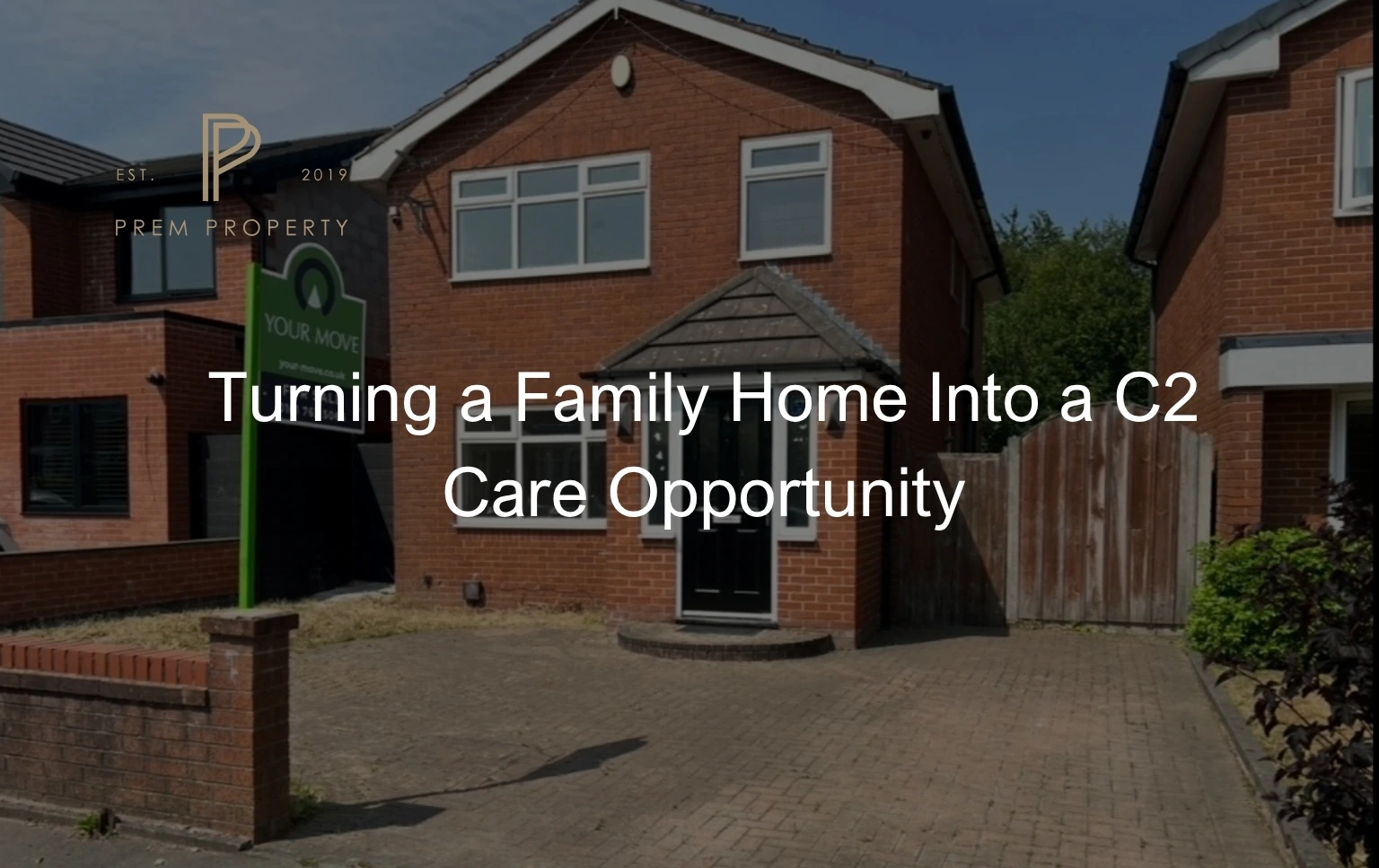
For many landlords, a much-loved family house is not the first place that comes to mind when thinking about a C2 care opportunity. Yet, a growing number of UK property owners are discovering that a well-located, spacious detached home can be transformed into a high-specification children’s residential care home while retaining its character and place within the local community. Understanding how a property can transition from a traditional residential use into specialist accommodation begins with assessing factors such as planning, layout and operational suitability, including the difference between C3 dwelling use and C2 residential use.
This matters because demand for suitable residential care homes for children continues to create challenges for providers looking for appropriate accommodation across the UK, particularly in areas such as Greater Manchester and the wider North West. For landlords exploring alternative property strategies, a C2 care opportunity can provide the potential for a long-term, professionally managed arrangement while contributing towards better housing solutions for vulnerable young people. Any proposed change of use must be carefully considered, with guidance available through the UK Government Planning Portal and relevant planning authorities before progressing.
Key Takeaways
- A C2 residential opportunity converts a standard family home into a specialist care setting for children or supported living.
- Full C2 change of use planning permission is now strongly preferred by most providers over a certificate of lawful use and development.
- Layout, parking and garden space all influence how many children a property can safely accommodate.
- Refurbishment to bring a home up to HMO-style fire and safety specification typically runs into several thousand pounds.
- Provider covenant strength, lease length and rent review clauses should be agreed before marketing begins.
- Working with an experienced property procurement partner reduces the risk of delay, rejection or an unsuitable placement.
Understanding the C2 Residential Opportunity
A C2 residential opportunity arises when a property currently used as an ordinary dwelling (C3 use) is reassessed for C3 dwelling use conversion into a residential institution, which is what a children’s home, supported living scheme or residential care home for adults legally requires. The distinction between these use classes is set out in the Town and Country Planning (Use Classes) Order 1987, and understanding it is the first step for any landlord considering this route.
For property investors and landlords, the appeal lies in the combination of a long, corporate-backed lease with a genuine social outcome. Rather than a rolling assured shorthold tenancy, a care provider typically signs a multi-year full repairing and insuring (FRI) lease, giving the landlord a predictable income stream and a tenant with a strong incentive to maintain the property to a high standard, since their own Ofsted registration depends on it.
Why the Opportunity Matters Right Now
Councils across England continue to report a shortage of registered children’s home placements, and providers are actively seeking suitable detached and semi-detached properties in quiet residential settings. However, the market has also become more selective. Providers increasingly want to see planning certainty before committing serious time to a property, which changes how landlords should approach the early stages of the process.
Property Example: A Detached Family Home in Greater Manchester
To illustrate how this assessment works in practice, we can look at a property opportunity review carried out for a fully detached four-bedroom home in Heywood, Rochdale. The landlord’s family had lived in the house for years, and the property came to Prem Property’s attention through a personal referral rather than open marketing. No personal or confidential details are included below; the figures and layout are shared purely as an educational example of how a suitability assessment is carried out.
The property sits on a quiet cul-de-sac with minimal passing traffic, within a semi-rural pocket of the borough, close to a local secondary school, the M60 motorway and Rochdale railway station. These locality factors matter more than many landlords initially expect, since providers commissioning placements consider transport links, school access and neighbourhood character alongside the building itself.
| Property Detail | Information |
|---|---|
| Location | Heywood, Rochdale, Greater Manchester |
| Property Type | Fully detached house |
| Bedrooms | 4 (3 doubles, 1 single) |
| Bathrooms | 2, including a private en-suite to the main bedroom |
| Layout | Open-plan kitchen and dining area, separate family living room |
| Outdoor Space | Large enclosed rear garden with established fruit trees |
| Potential Use | 2 to 3 child residential children’s home or supported living |
Property Suitability and Layout Considerations
When assessing whether a family home is suitable for a C2 care home conversion, the internal layout is just as important as the number of bedrooms. In this example, the main bedroom with its private en-suite and walk-in wardrobe was well suited to become a child’s room, while a second good-sized bedroom offered similar potential. The two smaller bedrooms were less appropriate as child bedrooms under typical provider standards, and instead were assessed as a possible staff office and a communal or games space.
This kind of reallocation is common. Providers commissioning a childrens residential home generally prefer a small, supervised room near the entrance or stairwell that can double as a staff office, both for practical oversight and to satisfy Ofsted’s expectations around safeguarding and sightlines. An open-plan ground floor, while attractive to a family buyer, can actually reduce the number of children a home is assessed as suitable for, since providers need clear sightlines and defined communal zones rather than one large uninterrupted space.
Location Considerations
Beyond the property itself, providers weigh up the surrounding area carefully. A cul-de-sac setting away from a busy main road is generally favoured, as is proximity to schools, healthcare and good transport links without being directly adjacent to a town centre. Off-road parking for two or more vehicles supports staff shift rotations, which matter more than many landlords initially realise, since a typical children’s home operates with staff working in shifts around the clock.
Planning Considerations
Planning is, without question, the area that causes landlords the most anxiety, and rightly so. A full C2 planning application requires the local authority to consult neighbours and consider the impact of the change of use, whereas a certificate of lawful use and development (CLEUD) does not involve the same neighbour consultation. As a result, a growing number of providers now prefer full planning permission, since a CLEUD carries a greater perceived risk of later challenge or closure if Ofsted or a future review raises concerns about the property’s planning status.
Guidance on the change of use process itself is available through the Planning Portal, and landlords in England can check the current framework governing local decision-making via the National Planning Policy Framework. Local planning departments, such as those covering Rochdale, publish their own planning application guidance and it is worth contacting them directly for an informal steer on local appetite for C2 applications before committing significant funds to drawings and supporting documents.
It is also worth noting that planning sentiment can vary sharply by region and even by neighbouring borough. Landlords should not assume that a difficult planning climate reported in one area applies uniformly everywhere, and should seek up-to-date, area-specific feedback rather than relying on general market commentary.
Layout Requirements and Compliance Considerations
Once planning is progressing, attention turns to bringing the property up to the physical standard providers expect. This typically includes fire doors throughout, an interlinked smoke and heat alarm system, a fire control panel and emergency lighting, broadly mirroring the standard expected in a house in multiple occupation. Guidance on assessing fire risk in this type of residential setting is set out in government fire safety risk assessment guidance, and landlords should budget realistically for this work rather than treating it as a minor afterthought.
Costs vary by property size and existing specification, but as a rough guide, fire doors are often priced per door installed, with a full interlinked alarm and detection system adding a further material sum on top. Some providers, particularly those with more established operations, will contribute toward this refurbishment or agree a shared schedule of works, though landlords should plan on the basis that this cost sits with them unless otherwise agreed in writing.
Provider Expectations and Compliance Considerations
Care providers bring their own operational standards on top of planning and building requirements. Most will only consider properties once Ofsted’s registration requirements can realistically be met, and many now request evidence of a provider’s own track record, current placements and financial standing before a landlord commits to them, sometimes called a covenant strength brief. It is entirely reasonable for a landlord to ask a prospective provider how long they have operated, how many homes they currently run and whether they can provide a director’s guarantee, particularly for newer operators.
The regulatory framework for children’s homes in England is set out in the Children’s Homes (England) Regulations 2015, supported by Ofsted’s own quality standards guidance. Familiarity with these standards, even at a high level, helps landlords ask better questions during provider onboarding and avoid unrealistic expectations about turnaround times.
Long-Term Management and Commercial Structure
A well-structured property lease protects both parties over the life of the agreement. In the Heywood property example, the commercial terms under discussion included a long-term FRI lease, a target rent aligned with local market comparables, a modest deposit and an annual rent review linked to CPI. Lease terms in this sector commonly run between five and fifteen years, with break clauses and rent reviews built in at agreed intervals, giving both the landlord and the provider a fair opportunity to reassess the arrangement over time.
| Area | Why It Matters |
|---|---|
| Planning | Determines whether the property can legally operate as a C2 use and how quickly it can be marketed to providers |
| Location | Influences provider interest, placement suitability and long-term demand from commissioning bodies |
| Layout | Affects how many children the property can accommodate and where staff and communal areas sit |
| Provider Requirements | Shapes refurbishment scope, lease structure and the overall commercial terms of the agreement |
| Management | Determines how smoothly the property runs day to day once the lease and provider are in place |
Landlords retaining a long-term interest in a property may also wish to consider first refusal or option-to-buy clauses if a provider later expresses interest in purchasing rather than leasing. These clauses can be structured flexibly, though any binding sale price agreed years in advance deserves careful thought, ideally with independent legal advice and a check of current values through HM Land Registry’s property information service.
How Prem Property Supports the Process
Navigating C2 planning, refurbishment, provider vetting and lease negotiation is a great deal to manage alongside a full-time job or an existing property portfolio. Prem Property works alongside landlords across the areas we cover, coordinating planning consultants, capital allowance specialists and finance brokers, and introducing vetted care providers only once a property has been properly assessed. Weekly updates keep landlords informed at every stage, from initial feasibility through to viewings and lease completion.
Landlords interested in exploring whether their own property might suit a similar route can review examples of completed opportunities in our case studies, check current demand through our C2 deal sheet or book a discovery call to discuss a specific property.
Frequently Asked Questions
What is a C2 residential opportunity? It is the process of changing a property’s planning use from an ordinary dwelling to a residential institution, allowing it to legally operate as a children’s home, supported living scheme or residential care home.
Can any property become a C2 residential property? Not every property is suitable. Layout, room sizes, garden space, parking and location all affect whether a property meets provider requirements, and a full planning application will still need to be approved by the local authority.
What is the difference between C3 and C2 use? C3 covers ordinary dwellings used by a single household, while C2 covers residential institutions providing care, such as children’s homes and supported living. Moving between the two typically requires a full change of use planning application.
Why is provider feedback important during the process? Providers bring operational experience that shapes layout decisions, refurbishment priorities and lease terms, helping ensure the finished property meets both planning requirements and day-to-day care standards.
How can Prem Property help landlords with this process? Prem Property manages the end-to-end process, including planning guidance, provider introductions, refurbishment coordination and lease negotiation, so landlords have a single point of contact throughout. Get in touch with our team to find out more.
In Summary
Turning a family home into a C2 residential opportunity is rarely a quick process, but for landlords willing to work through planning, refurbishment and provider vetting properly, it can deliver a long, stable lease alongside a genuine community benefit. Careful assessment of layout, location and compliance requirements at the outset saves time and money later, and working with an experienced partner helps landlords avoid the pitfalls that can derail a promising property.
Save Time. Grow Faster. Impact Communities. With Prem Property.